
Mostrar el registro sencillo del ítem
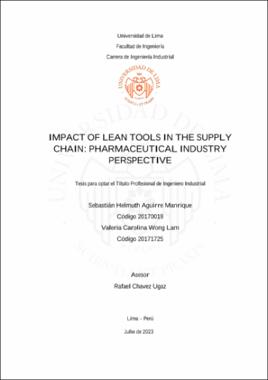
Impact of Lean Tools in the Supply Chain: Pharmaceutical Industry Perspective
| dc.contributor.advisor | Chávez Ugáz, Rafael | |
| dc.contributor.author | Aguirre Manrique, Sebastián Helmuth | |
| dc.contributor.author | Wong Lam, Valeria Carolina | |
| dc.date.accessioned | 2023-09-22T16:46:22Z | |
| dc.date.available | 2023-09-22T16:46:22Z | |
| dc.date.issued | 2023 | |
| dc.identifier.citation | Aguirre Manrique, S. H. & Wong Lam, V. C. (2023). Impact of Lean Tools in the Supply Chain: Pharmaceutical Industry Perspective [Tesis para optar el Título Profesional de Ingeniero Industrial, Universidad de Lima]. Repositorio institucional de la Universidad de Lima. https://hdl.handle.net/20.500.12724/19013 | es_PE |
| dc.identifier.uri | https://hdl.handle.net/20.500.12724/19013 | |
| dc.description.abstract | The aim of this paper is to identify the impact of the application of lean tools in the pharmaceutical supply chain (PSC) through a literature review. Supply chain inefficiencies before and during the COVID 19 pandemic, most applied tools, and lean improvements found in the PSC are identified. Databases such as Scopus and Proquest were used to collect the peer-reviewed articles to be studied. Results show the most frequent inefficiencies in the supply chain are found in operating costs, scrap rates, delivery times, and drug shortages. The improvements identified can be summarized in three factors: cost reduction, time reduction, and improvement in the management of activities. The most studied tools are Kaizen, Kanban, Total Quality Management (TQM), and Value Stream Mapping (VSM). Literature reveals that lean tools have a significant impact on quality improvement of information, products and/or services, as well as on the reduction or elimination of activities that do not generate value; in addition, there is little evidence of reduction of unnecessary movements of workers. The value of this paper addresses the impact of the pandemic on PSC, describing the versatility that each of the tools had in their role to reduce lean wastes. The versatility allows to identify which tool may be available according to the need of the practitioner. | es_PE |
| dc.format | application/pdf | |
| dc.language.iso | eng | |
| dc.publisher | Universidad de Lima | |
| dc.rights | info:eu-repo/semantics/openAccess | * |
| dc.rights.uri | https://creativecommons.org/licenses/by-nc-sa/4.0/ | * |
| dc.source | Repositorio Institucional - Ulima | |
| dc.source | Universidad de Lima | |
| dc.subject | Producción eficiente | es_PE |
| dc.subject | Industria farmaceútica | es_PE |
| dc.subject | Cadena de suministro | es_PE |
| dc.subject | Revisión bibliográfica | es_PE |
| dc.subject | Lean manufacturing | es_PE |
| dc.subject | Pharmaceutical industry | es_PE |
| dc.subject | Supply chain | es_PE |
| dc.subject | Bibliographical revision | es_PE |
| dc.title | Impact of Lean Tools in the Supply Chain: Pharmaceutical Industry Perspective | es_PE |
| dc.type | info:eu-repo/semantics/bachelorThesis | |
| thesis.degree.level | Título Profesional | |
| thesis.degree.discipline | Ingeniería Industrial | es_PE |
| thesis.degree.grantor | Universidad de Lima. Facultad de Ingeniería y Arquitectura | |
| dc.publisher.country | PE | |
| dc.type.other | Tesis | |
| thesis.degree.name | Ingeniero Industrial | |
| renati.advisor.orcid | https://orcid.org/0000-0002-9450-0158 | |
| renati.discipline | 722026 | |
| dc.identifier.isni | 121541816 | |
| renati.author.dni | 74737275 | |
| renati.author.dni | 74301943 | |
| renati.level | https://purl.org/pe-repo/renati/level#tituloProfesional | * |
| renati.advisor.dni | 09539644 | |
| renati.juror | Santos Figueroa, Luis Enrique | |
| renati.juror | Cabrera Gil Grados, Ezilda Maria | |
| renati.juror | Chávez Ugáz, Rafael | |
| renati.type | https://purl.org/pe-repo/renati/type#tesis | * |
| dc.subject.ocde | https://purl.org/pe-repo/ocde/ford#2.11.04 | |
| ulima.cat | 15 |
Ficheros en el ítem



Este ítem aparece en la(s) siguiente(s) colección(ones)
-
Tesis [1226]

Excepto si se señala otra cosa, la licencia del ítem se describe como info:eu-repo/semantics/openAccess