
Mostrar el registro sencillo del ítem
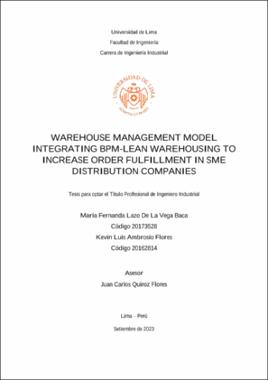
Warehouse management model integrating BPM-Lean Warehousing to increase order fulfillment in SME distribution companies
| dc.contributor.advisor | Quiroz Flores, Juan Carlos | |
| dc.contributor.author | Ambrosio Flores, Kevin Luis | |
| dc.contributor.author | Lazo de La Vega Baca, Maria Fernanda | |
| dc.date.accessioned | 2023-11-15T21:07:22Z | |
| dc.date.available | 2023-11-15T21:07:22Z | |
| dc.date.issued | 2023 | |
| dc.identifier.citation | Ambrosio Flores, K. L., & Lazo de La Vega Baca, M. F. (2023). Warehouse management model integrating BPM-Lean Warehousing to increase order fulfillment in SME distribution companies [Tesis para optar el Título Profesional de Ingeniero Industrial, Universidad de Lima]. Repositorio institucional de la Universidad de Lima. https://hdl.handle.net/20.500.12724/19314 | es_PE |
| dc.identifier.uri | https://hdl.handle.net/20.500.12724/19314 | |
| dc.description.abstract | In many cases, warehouse logistics in the distribution SMEs usually do not have a standardization, structure, and methodology for the reception, storage, and dispatch. Most of the flows within the warehouse tend to occur over time, but there is no feedback or a choice of logistics tools to make it more efficient. This lack of tools causes problems such as a non-existent flow of information, a lack of warehouse organization, inventory control, and a non-existent work protocol. These problems cause the customer satisfaction index to shallow since mishaps usually occur during order delivery. The general objective of this research is to increase the indicator of complete orders, so the root causes of the problem are identified and quantified. After that, a model based on implementing Lean Warehousing tools such as multi-criteria ABC, 5S, Kardex and work standardization, and BPM methodology was also applied. Subsequently, the model's reliability was guaranteed using a simulation through Arena software and a pilot test. Finally, the model increased the indicator of orders entirely delivered by 12%. Likewise, as a secondary consequence, other indicators were increased: inventory record accuracy, location registration accuracy, coverage, cycle time, and productivity by 16%, 32%, 57%, 3%, and 24%, respectively. | en_EN |
| dc.description.abstract | En muchos casos, la logística de almacén en las PYMES de distribución no suele contar con una normalización, estructura y metodología para la recepción, el almacenamiento y la expedición. La mayoría de los flujos dentro del almacén suelen producirse a lo largo del tiempo, pero no existe una retroalimentación ni una elección de herramientas logísticas para hacerlo más eficiente. Esta falta de herramientas provoca problemas como un flujo de información inexistente, una falta de organización del almacén, un control del inventario y un protocolo de trabajo inexistente. Estos problemas provocan que el índice de satisfacción del cliente descienda, ya que suelen producirse contratiempos durante la entrega de los pedidos. El objetivo general de esta investigación es aumentar el indicador de pedidos completos, por lo que se identifican y cuantifican las causas fundamentales del problema. A continuación, se aplica un modelo basado en la implantación de herramientas de Lean Warehousing como el ABC multicriterio, las 5S, el Kardex y la estandarización del trabajo, así como la metodología BPM. Posteriormente, se garantizó la fiabilidad del modelo mediante una simulación a través del software Arena y una prueba piloto. Finalmente, el modelo incrementó en un 12% el indicador de pedidos entregados en su totalidad. Asimismo, como consecuencia secundaria, se incrementaron otros indicadores: precisión del registro de inventario, precisión del registro de ubicación, cobertura, tiempo de ciclo y productividad en un 16%, 32%, 57%, 3% y 24%, respectivamente. | es_PE |
| dc.format | application/pdf | |
| dc.language.iso | eng | |
| dc.publisher | Universidad de Lima | |
| dc.rights | info:eu-repo/semantics/restrictedAccess | * |
| dc.source | Repositorio Institucional - Ulima | |
| dc.source | Universidad de Lima | |
| dc.subject | Gestión de almacenes | es_PE |
| dc.subject | Reparto de mercancías | es_PE |
| dc.subject | Pequeñas y medianas empresas | es_PE |
| dc.subject | Warehouses management | en_EN |
| dc.subject | Delivery of goods | en_EN |
| dc.subject | Small business | en_EN |
| dc.title | Warehouse management model integrating BPM-Lean Warehousing to increase order fulfillment in SME distribution companies | en_EN |
| dc.type | info:eu-repo/semantics/bachelorThesis | |
| thesis.degree.level | Título Profesional | es_PE |
| thesis.degree.discipline | Ingeniería Industrial | es_PE |
| thesis.degree.grantor | Universidad de Lima. Facultad de Ingeniería y Arquitectura | es_PE |
| dc.publisher.country | PE | |
| dc.type.other | Tesis | |
| thesis.degree.name | Ingeniero Industrial | es_PE |
| renati.advisor.orcid | https://orcid.org/0000-0003-1858-4123 | |
| renati.discipline | 722026 | |
| dc.identifier.isni | 121541816 | |
| renati.author.dni | 74135780 | |
| renati.author.dni | 75436111 | |
| renati.level | https://purl.org/pe-repo/renati/level#tituloProfesional | * |
| renati.advisor.dni | 10300285 | |
| renati.juror | Santos Figueroa, Luis Enrique | |
| renati.juror | Quiroz Flores, Juan Carlos | |
| renati.juror | Flores Pérez, Alberto Enrique | |
| renati.type | https://purl.org/pe-repo/renati/type#tesis | * |
| dc.subject.ocde | https://purl.org/pe-repo/ocde/ford#2.11.04 | |
| ulima.cat | 015 |
Ficheros en el ítem


Este ítem aparece en la(s) siguiente(s) colección(ones)
-
Tesis [1236]