
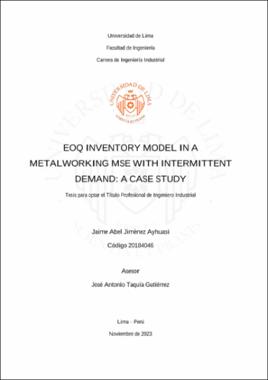
EOQ Inventory Model in a Metalworking MSE with Intermittent Demand: A Case Study.
| dc.contributor.advisor | Taquía Gutiérrez, José Antonio | |
| dc.contributor.author | Jiménez Ayhuasi, Jaime Abel | |
| dc.date.accessioned | 2024-04-01T19:15:47Z | |
| dc.date.available | 2024-04-01T19:15:47Z | |
| dc.date.issued | 2023 | |
| dc.identifier.citation | Jiménez Ayhuasi, J. A. (2023). EOQ Inventory Model in a Metalworking MSE with Intermittent Demand: A Case Study [Tesis para optar el Título Profesional de Ingeniero Industrial, Universidad de Lima]. Repositorio institucional de la Universidad de Lima. https://hdl.handle.net/20.500.12724/20096 | es_PE |
| dc.identifier.uri | https://hdl.handle.net/20.500.12724/20096 | |
| dc.description.abstract | The main objective of this research article is to optimize costs and logistic KPIs applying an economic order quantity (EOQ) inventory model in a metalmechanic MSE with intermittent demand. Firstly, the forecast model with the lowest MAD and ECM is selected. The object under study, after ABC classification, belongs to the family of products located in class A due to its valuation and participation in the inventory. The Croston method is considered the most effective forecast model. Secondly, an aggregate planning is developed to satisfy the projection. Then, the EOQ or Wilson model is implemented to reduce inventory costs. Finally, to validate the calculated data, a simulation model is built in Arena with 50 replications. As a result, the inventory costs were reduced to 22.6%. | en_EN |
| dc.description.abstract | El presente artículo de investigación tiene como objetivo principal optimizar costos y KPIs logísticos mediante la aplicación de un modelo de inventario (EOQ) en una MYPE metalmecánica con demanda intermitente. El objeto en estudio, luego de la clasificación ABC, corresponde a la familia ubicados en la clase A por su valorización y participación en el inventario. En primer lugar, se selecciona el modelo de pronóstico con la MAD (desviación media) y ECM (error cuadrático) más bajo. El método de Croston se considera el modelo de pronóstico más efectivo. En segundo lugar, se desarrolla una planificación agregada para satisfacer la proyección. Luego, se implementa el sistema EOQ o modelo Wilson para reducir los costos de inventario. Finalmente, para validar los datos calculados, se construye un modelo de simulación en Arena con 50 repeticiones. Como resultado, los costos de inventario se redujeron a 22.6% | es_PE |
| dc.format | application/pdf | |
| dc.language.iso | eng | |
| dc.publisher | Universidad de Lima | |
| dc.rights | info:eu-repo/semantics/openAccess | * |
| dc.rights.uri | https://creativecommons.org/licenses/by-nc-sa/4.0/ | * |
| dc.source | Repositorio Institucional - Ulima | |
| dc.source | Universidad de Lima | |
| dc.subject | Gestión de stocks | es_PE |
| dc.subject | Pequeñas y medianas empresas | es_PE |
| dc.subject | Industria metalmecánica | es_PE |
| dc.subject | Estudio de casos | es_PE |
| dc.title | EOQ Inventory Model in a Metalworking MSE with Intermittent Demand: A Case Study. | es_PE |
| dc.type | info:eu-repo/semantics/bachelorThesis | |
| thesis.degree.level | Título Profesional | |
| thesis.degree.discipline | Ingeniería Industrial | es_PE |
| thesis.degree.grantor | Universidad de Lima. Facultad de Ingeniería y Arquitectura | |
| dc.publisher.country | PE | |
| dc.type.other | Tesis | |
| thesis.degree.name | Ingeniero Industrial | |
| renati.advisor.orcid | https://orcid.org/0000-0002-1711-6603 | |
| renati.discipline | 722026 | |
| dc.identifier.isni | 121541816 | |
| renati.author.dni | 73348671 | |
| renati.level | https://purl.org/pe-repo/renati/level#tituloProfesional | * |
| renati.advisor.dni | 9994370 | |
| renati.juror | Chavez Ugáz, Rafael | |
| renati.juror | Garcia Lopez, Yvan Jesus | |
| renati.juror | Taquía Gutiérrez, José Antonio | |
| renati.type | https://purl.org/pe-repo/renati/type#tesis | * |
| dc.subject.ocde | https://purl.org/pe-repo/ocde/ford#2.11.04 | |
| ulima.cat | OI |
Files in this item



This item appears in the following Collection(s)
-
Tesis [1230]

Except where otherwise noted, this item's license is described as info:eu-repo/semantics/openAccess