
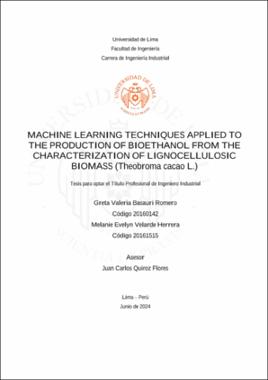
Machine learning techniques applied to the production of bioethanol from the characterization of lignocellulosic biomass (Theobroma cacao l.)
| dc.contributor.advisor | Quiroz Flores, Juan Carlos | |
| dc.contributor.author | Basauri Romero, Greta Valeria | |
| dc.contributor.author | Velarde Herrera, Melanie Evelyn | |
| dc.date.accessioned | 2024-06-21T13:12:53Z | |
| dc.date.available | 2024-06-21T13:12:53Z | |
| dc.date.issued | 2024 | |
| dc.identifier.citation | Basauri Romero, G. V., & Velarde Herrera, M. E. (2024). Machine learning techniques applied to the production of bioethanol from the characterization of lignocellulosic biomass (Theobroma cacao l.) [Tesis para optar el Título Profesional de Ingeniero Industrial, Universidad de Lima]. Repositorio Institucional de la Universidad de Lima. https://hdl.handle.net/20.500.12724/20743 | es_PE |
| dc.identifier.uri | https://hdl.handle.net/20.500.12724/20743 | |
| dc.description.abstract | En los últimos años, la demanda de combustibles fósiles ha ido en aumento y esto ha generado una escasez en las reservas mundiales lo que limita el crecimiento económico; ejemplo de ello es Tocache, una de las provincias más aisladas y pobres del Perú. En este estudio se aborda el uso de residuos lignocelulósicos como la cáscara de cacao para generar biocombustible, cuyo objetivo es comparar los resultados experimentales con los obtenidos de la simulación. Asimismo, se realizaron los procesos de pretratamiento, hidrólisis enzimática y fermentación en la Universidad Técnica de Machala. El Machine Learning se realizó con el software Orange, el cual se basó en los datos y las variables experimentales halladas previamente. El mejor resultado corresponde al método Random Forest, con el que se obtuvo una precisión con el R2 (0.83). Por consiguiente, la glucosa predicha fue 1.04 g/L y la cantidad óptima de alcohol etílico fue 5.34 g / L. Los resultados demuestran que el alcohol etílico simulado se aproxima al hallado experimentalmente (7.1 g/L) y a otros estudios realizados previamente. Finalmente, el uso de Machine Learning es menos costoso y los resultados se pueden obtener en el menor tiempo posible en comparación con los procedimientos experimentales. | es_PE |
| dc.description.abstract | In recent years, the demand for fossil fuels has been increasing and this has generated a shortage in world reserves, which limits economic growth; An example of this is Tocache, one of the most isolated and poorest provinces in Peru. This study deals with the use of lignocellulosic residues such as cocoa husks to generate biofuel, whose objective is to compare the experimental results with those obtained from the simulation. Furthermore, the pretreatment, enzymatic hydrolysis and fermentation processes were carried out at the Technical University of Machala. The Machine Learning was carried out with the orange software, which was based on the data and the experimental variables previously found. The best result corresponds to the Random Forest method, with which a precision with R2 (0.83) was obtained. Therefore, the predicted glucose was 1.04 g/L, and the optimal amount of ethyl alcohol was 5.34 g/L. The results show that the simulated ethyl alcohol is close to that found experimentally (7.1 g/L) and to previous studies. Finally, the use of Machine Learning is less expensive, and the results can be obtained in the shortest possible time compared to experimental procedures. | en_EN |
| dc.format | application/pdf | |
| dc.language.iso | eng | |
| dc.publisher | Universidad de Lima | |
| dc.rights | info:eu-repo/semantics/openAccess | * |
| dc.rights.uri | https://creativecommons.org/licenses/by-nc-sa/4.0/ | * |
| dc.source | Repositorio Institucional - Ulima | |
| dc.source | Universidad de Lima | |
| dc.subject | Aprendizaje automático | es_PE |
| dc.subject | Bioetanol | es_PE |
| dc.subject | Biocombustibles | es_PE |
| dc.subject | Producción | es_PE |
| dc.subject | Machine learning | en_EN |
| dc.subject | Bioethanol | en_EN |
| dc.subject | Biofuel | en_EN |
| dc.subject | Production | en_EN |
| dc.title | Machine learning techniques applied to the production of bioethanol from the characterization of lignocellulosic biomass (Theobroma cacao l.) | en_EN |
| dc.type | info:eu-repo/semantics/bachelorThesis | |
| thesis.degree.level | Título Profesional | |
| thesis.degree.discipline | Ingeniería Industrial | es_PE |
| thesis.degree.grantor | Universidad de Lima. Facultad de Ingeniería | |
| dc.publisher.country | PE | |
| dc.type.other | Tesis | |
| thesis.degree.name | Ingeniero Industrial | |
| renati.advisor.orcid | https://orcid.org/0000-0003-1858-4123 | |
| renati.discipline | 722026 | |
| dc.identifier.isni | 121541816 | |
| renati.author.dni | 73690491 | |
| renati.author.dni | 72873502 | |
| renati.level | https://purl.org/pe-repo/renati/level#tituloProfesional | * |
| renati.advisor.dni | 10300285 | |
| renati.juror | Calderon Gonzales, Wilson David | |
| renati.juror | Flores Pérez, Alberto Enrique | |
| renati.juror | Quiroz Flores, Juan Carlos | |
| renati.type | https://purl.org/pe-repo/renati/type#tesis | * |
| dc.subject.ocde | https://purl.org/pe-repo/ocde/ford#2.11.04 | |
| ulima.cat | 009 |
Files in this item


This item appears in the following Collection(s)
-
Tesis [1230]

Except where otherwise noted, this item's license is described as info:eu-repo/semantics/openAccess