
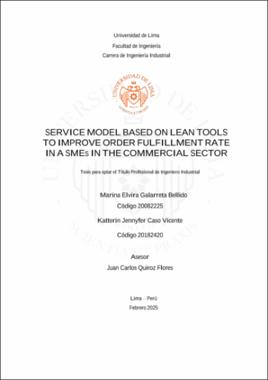
Service model based on lean tools to improve order fulfillment rate in a SMES in the commercial sector
| dc.contributor.advisor | Quiroz Flores, Juan Carlos | |
| dc.contributor.author | Galarreta Bellido, Marina Elvira | |
| dc.contributor.author | Caso Vicente, Katterin Jennyfer | |
| dc.date.accessioned | 2025-05-21T00:21:44Z | |
| dc.date.available | 2025-05-21T00:21:44Z | |
| dc.date.issued | 2025 | |
| dc.identifier.uri | https://hdl.handle.net/20.500.12724/22674 | |
| dc.description.abstract | The commercial sector has experienced steady growth in recent years. However, there are problems within logistics that are detrimental to customer satisfaction; the objective of companies is to deliver orders on time and minimize economic losses. That said, in this research, the problem that generates the greatest economic losses is the high percentage of unfulfilled orders. To address it, it is proposed to reduce this gap through a model based on Lean methodology, using methodologies such as 5S, ABC and Kanban, which allows improving the indicators. The research is based on internal logistics in a warehouse where the root causes of the problem are identified and quantified, and then attacked using Lean tools. Finally, through simulations with Arena software, it was demonstrated that the proposed model achieves a 38.8% reduction in picking time, 12.2% in system registration and 7.23% in total simulation time, which improves delivery compliance, reaching a target of 5% of unfulfilled orders. | en_EN |
| dc.description.abstract | El sector comercial ha experimentado un crecimiento constante en los últimos años. Sin embargo, existen problemas dentro de la logística que van en detrimento de la satisfacción del cliente; el objetivo de las empresas es entregar los pedidos a tiempo y minimizar las pérdidas económicas. Dicho esto, en la presente investigación, el problema que genera mayores pérdidas económicas es el alto porcentaje de pedidos incumplidos. Para abordarlo, se propone reducir esta brecha mediante un modelo basado en la metodología Lean, utilizando metodologías como 5S, ABC y Kanban, lo que permite mejorar los indicadores. La investigación se basa en la logística interna en un almacén donde se identifican y cuantifican las causas raíz del problema, para posteriormente atacarlas utilizando herramientas Lean. Finalmente, a través de simulaciones con el software Arena, se demostró que el modelo propuesto logra una reducción del 38.8% en el tiempo de picking, 12.2% en el registro al sistema y 7.23% en el tiempo total de simulación, lo que mejora el cumplimiento de las entregas, alcanzando un objetivo del 5% de pedidos incumplidos. | es_PE |
| dc.format | application/pdf | |
| dc.language.iso | eng | |
| dc.publisher | Universidad de Lima | |
| dc.rights | info:eu-repo/semantics/openAccess | |
| dc.rights.uri | https://creativecommons.org/licenses/by-nc-sa/4.0/ | * |
| dc.subject | Producción eficiente | es_PE |
| dc.subject | Sistemas de preparación de pedidos | es_PE |
| dc.subject | Pequeñas y medianas empresas | es_PE |
| dc.subject | Gestión de almacenes | es_PE |
| dc.subject | Logística empresarial | es_PE |
| dc.subject | Simulación por computadora | es_PE |
| dc.title | Service model based on lean tools to improve order fulfillment rate in a SMES in the commercial sector | en_EN |
| dc.type | info:eu-repo/semantics/bachelorThesis | |
| thesis.degree.level | Título Profesional | |
| thesis.degree.discipline | Ingeniería Industrial | es_PE |
| thesis.degree.grantor | Universidad de Lima. Facultad de Ingeniería | |
| dc.publisher.country | PE | |
| dc.type.other | Tesis | |
| thesis.degree.name | Ingeniero Industrial | |
| renati.advisor.orcid | https://orcid.org/0000-0003-1858-4123 | |
| renati.discipline | 722026 | |
| dc.identifier.isni | 0000000121541816 | |
| renati.author.dni | 43906969 | |
| renati.author.dni | 71724204 | |
| renati.level | https://purl.org/pe-repo/renati/level#tituloProfesional | * |
| renati.advisor.dni | 10300285 | |
| renati.juror | Cabrera Gil Grados, Ezilda Maria | |
| renati.juror | Urbina Rivera, Carlos Medardo | |
| renati.juror | Quiroz Flores, Juan Carlos | |
| renati.type | https://purl.org/pe-repo/renati/type#tesis | * |
| dc.subject.ocde | https://purl.org/pe-repo/ocde/ford#2.11.04 | |
| ulima.cat | OI |
Files in this item


This item appears in the following Collection(s)
-
Tesis [1237]

Except where otherwise noted, this item's license is described as info:eu-repo/semantics/openAccess