
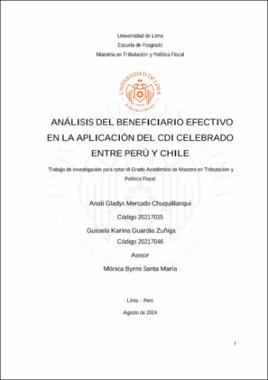
Análisis del beneficiario efectivo en la aplicación del CDI celebrado entre Perú y Chile
| dc.contributor.advisor | Byrne Santa María, Mónica Lucía | |
| dc.contributor.author | Guardia Zúñiga, Guissela Karina | |
| dc.contributor.author | Mercado Chuquillanqui, Analí Gladys | |
| dc.date.accessioned | 2025-05-21T00:24:28Z | |
| dc.date.available | 2025-05-21T00:24:28Z | |
| dc.date.issued | 2024 | |
| dc.identifier.uri | https://hdl.handle.net/20.500.12724/22718 | |
| dc.description.abstract | En la presente investigación, se analizará el término beneficiario efectivo, el cual se encuentra comprendido en los tratados internaciones y no cuenta con una definición o alcance ocasionando que los países asuman diferentes posturas, algunas asumiendo un enfoque basado en el criterio de atribución y otras con un enfoque de cláusula antielusiva; lo cual, ha generado como consecuencia un problema de fiscalidad internacional. A pesar de haber pasado muchos años desde que se introdujo este concepto en el modelo de convenio OCDE de 1976, hasta la actualidad no se cuenta con un pronunciamiento claro del OCDE, organización que consideramos que es la más indicada para establecer el alcance y delimitación del beneficiario efectivo y evitar problemas de inseguridad jurídica. Esta carencia de definición ha generado jurisprudencias a nivel internacional de criterios contradictorios y diversos alcances, y a partir del año 2020 surge en el Perú el primer fallo a nivel del Tribunal Fiscal peruano relacionado al cumplimiento de la condición de beneficiario efectivo, con una posición antielusiva mediante la cual deniega el aprovechamiento del convenio celebrado entre Perú y Chile a un proveedor no domiciliado asumiendo el contribuyente local la deuda en carácter de responsabilidad solidaria generando un precedente negativo a nuestro parecer, de incertidumbre e indefensión de aquellos contribuyentes que tengan operaciones transfronterizas. En este sentido consideramos importante analizar el origen de inclusión del término beneficiario efectivo en los convenios, el desarrollo del término en el tiempo a nivel de la OCDE así como en los fallos internacionales, analizando los criterios considerados que impactan a la efectividad del uso de los convenios y concluir cual sería la posible solución a implementarse para frenar las controversias en este sentido y de esta manera evitar que terminen quebrando el objeto por el que se crearon los tratados internacionales. | es_PE |
| dc.description.abstract | In this research, the concept of beneficial owner will be analyzed. This relevant term is found in international treaties and does not have a definition or scope, causing countries to take different positions, some assuming an approach based on the attribution criterion and others with an anti-avoidance clause approach, which has generated, consequently, an international tax problem. Even though many years have passed since this concept was introduced in the OECD model convention of 1976, to date there is no clear pronouncement from the OECD, an organization that we consider to be the most appropriate to establish the scope and delimitation of the beneficial owner and avoid legal security problems. This lack of definition has generated international jurisprudence with contradictory criteria and diverse scopes, and as of 2020, the first ruling at the level of the Peruvian Tax Court related to compliance with the beneficial owner requirement has emerged in Peru, with an anti-avoidance position in which the application of the benefits of the agreement between Peru and Chile is denied to a non-domiciled supplier, with the local taxpayer assuming the debt as joint liability, generating a negative precedent in our opinion, of uncertainty and defenselessness for those taxpayers who have cross-border operations. In this sense, we consider it important to analyze the origin of the inclusion of the term beneficial owner in the agreements, the evolution of the concept over time at the OECD level as well as in international rulings, analyzing the criteria considered that impact the effectiveness of the use of the agreements and concluding what would be the possible solution to be implemented to stop the controversies in this regard and in this way avoid that they end up breaking the object for which the international treaties were created. | en_EN |
| dc.format | application/pdf | |
| dc.language.iso | spa | |
| dc.publisher | Universidad de Lima | |
| dc.rights | info:eu-repo/semantics/openAccess | * |
| dc.rights.uri | https://creativecommons.org/licenses/by-nc-sa/4.0/ | * |
| dc.title | Análisis del beneficiario efectivo en la aplicación del CDI celebrado entre Perú y Chile | es_PE |
| dc.title.alternative | Analysis of the beneficial owner in the application of the CDI celebrated between Peru and Chile | en_EN |
| dc.type | info:eu-repo/semantics/masterThesis | |
| thesis.degree.level | Maestría | |
| thesis.degree.discipline | Tributación y Política Fiscal | es_PE |
| thesis.degree.grantor | Universidad de Lima. Escuela de Posgrado | |
| dc.publisher.country | PE | |
| dc.type.other | Trabajo de investigación | |
| thesis.degree.name | Maestro en Tributación y Política Fiscal | |
| renati.advisor.orcid | https://orcid.org/0009-0009-9497-1185 | |
| renati.discipline | 411527 | |
| dc.identifier.isni | 0000000121541816 | |
| renati.author.dni | 42617656 | |
| renati.author.dni | 45359870 | |
| renati.level | https://purl.org/pe-repo/renati/level#maestro | * |
| renati.advisor.dni | 06623653 | |
| renati.juror | Villanueva Gutiérrez, Walker | |
| renati.juror | Garret Vargas, Juan Alberto | |
| renati.juror | Byrne Santa María, Mónica Lucía | |
| renati.type | https://purl.org/pe-repo/renati/type#trabajoDeInvestigacion | * |
| dc.subject.ocde | https://purl.org/pe-repo/ocde/ford#5.05.00 | |
| ulima.cat | OI |
Files in this item


This item appears in the following Collection(s)

Except where otherwise noted, this item's license is described as info:eu-repo/semantics/openAccess