
Mostrar el registro sencillo del ítem
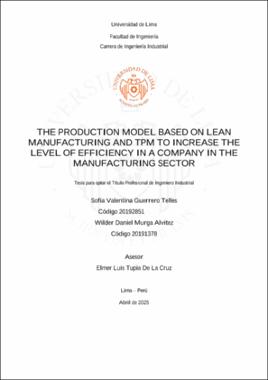
The production model based on Lean Manufacturing and TPM to increase the level of efficiency in a company in the manufacturing sector
| dc.contributor.advisor | Tupia De La Cruz, Elmer Luis | |
| dc.contributor.author | Guerrero Telles, Sofia Valentina | |
| dc.contributor.author | Murga Alvitez, Wilder Daniel | |
| dc.date.accessioned | 2025-07-08T20:15:26Z | |
| dc.date.available | 2025-07-08T20:15:26Z | |
| dc.date.issued | 2025 | |
| dc.identifier.uri | https://hdl.handle.net/20.500.12724/22906 | |
| dc.description.abstract | The present research focused on measuring the level of efficiency based on the implementation of Lean Manufacturing and TPM. Relevant data for the research were collected before and after the implementation to identify problems and design solutions based on Smed, Standardized Work and TPM. First, a root cause analysis was performed with the problem tree tool, where problems such as long set up stoppages, breakdowns, lack of maintenance, lack of training of the production team, among others, were identified. Therefore, a solution proposal was implemented based on the methodologies, which improved the efficiency level from 50% to 79.3%. Based on this, the application of the SMED tool focused on decreasing the setup time, the mold change lasted about 7.06 hours and decreased 5.97 hours. In the case of standard work, operational failures were reduced from 15% to 6%. On the other hand, the implementation of TPM increased the efficiency of the machinery together with preventive maintenance training for the equipment, which increased from 37.56% to 51.31%. Finally, these findings highlight the importance of implementing tools such as Lean Manufacturing and TPM in the manufacturing sector to increase the level of efficiency in the organization. | en_EN |
| dc.description.abstract | La presente investigación se centró en medir el nivel de eficiencia a partir de la implementación de Lean Manufacturing y TPM. Se recolectaron datos relevantes para la investigación antes y después de la implementación para identificar problemas y diseñar soluciones basadas en Smed, Trabajo Estandarizado y TPM. En primer lugar, se realizó un análisis de causa raíz con la herramienta árbol de problemas, donde se identificaron problemas como paradas prolongadas en el montaje, averías, falta de mantenimiento, falta de capacitación del equipo de producción, entre otros. Por lo que se implementó una propuesta de solución basada en las metodologías, la cual mejoró el nivel de eficiencia del 50% al 79,3%. En base a esto, la aplicación de la herramienta SMED se enfocó en disminuir el tiempo de setup, el cambio de molde duró alrededor de 7.06 horas y disminuyó 5.97 horas. En el caso de los trabajos estándar, las fallas operativas se redujeron del 15% al 6%. Por otro lado, la implementación del TPM incrementó la eficiencia de la maquinaria junto con la capacitación en mantenimiento preventivo de los equipos, la cual aumentó de 37.56% a 51.31%. Finalmente, estos hallazgos resaltan la importancia de implementar herramientas como Lean Manufacturing y TPM en el sector manufacturero para aumentar el nivel de eficiencia en la organización. | es_PE |
| dc.format | application/pdf | |
| dc.language.iso | eng | |
| dc.publisher | Universidad de Lima | |
| dc.rights | info:eu-repo/semantics/openAccess | |
| dc.rights.uri | https://creativecommons.org/licenses/by-nc-sa/4.0 | * |
| dc.subject | Industrias manufactureras | es_PE |
| dc.subject | Producción eficiente | es_PE |
| dc.subject | Mantenimiento productivo total | es_PE |
| dc.subject | Productividad | es_PE |
| dc.subject | Administración de la producción | es_PE |
| dc.subject | Normas de producción | es_PE |
| dc.title | The production model based on Lean Manufacturing and TPM to increase the level of efficiency in a company in the manufacturing sector | en_EN |
| dc.type | info:eu-repo/semantics/bachelorThesis | |
| thesis.degree.level | Título profesional | es_PE |
| thesis.degree.discipline | Ingeniería Industrial | es_PE |
| thesis.degree.grantor | Universidad de Lima. Facultad de Ingeniería | |
| dc.publisher.country | PE | |
| dc.type.other | Tesis | |
| thesis.degree.name | Ingeniero Industrial | |
| renati.advisor.orcid | https://orcid.org/0000-0001-8946-3041 | |
| renati.discipline | 722026 | |
| dc.identifier.isni | 0000000121541816 | |
| renati.author.dni | 73573168 | |
| renati.author.dni | 73176143 | |
| renati.level | https://purl.org/pe-repo/renati/level#tituloProfesional | * |
| renati.advisor.dni | 08052533 | |
| renati.juror | Quiroz Flores, Juan Carlos | |
| renati.juror | Almandoz Núñez, Ana Maria | |
| renati.juror | Tupia De La Cruz, Elmer Luis | |
| renati.type | https://purl.org/pe-repo/renati/type#tesis | * |
| dc.subject.ocde | https://purl.org/pe-repo/ocde/ford#2.11.04 | |
| ulima.cat | OI |
Ficheros en el ítem


Este ítem aparece en la(s) siguiente(s) colección(ones)
-
Tesis [1236]

Excepto si se señala otra cosa, la licencia del ítem se describe como info:eu-repo/semantics/openAccess