
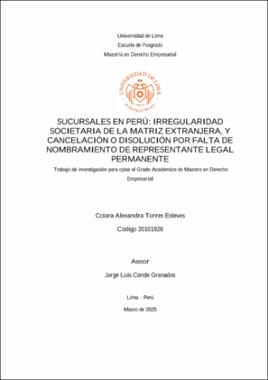
Sucursales en Perú: irregularidad societaria de la matriz extranjera, y cancelación o disolución por falta de nombramiento de representante legal permanente
| dc.contributor.advisor | Conde Granados, Jorge Luis | |
| dc.contributor.author | Torres Esteves, Cciara Alexandra | |
| dc.date.accessioned | 2025-08-07T13:00:55Z | |
| dc.date.available | 2025-08-07T13:00:55Z | |
| dc.date.issued | 2025 | |
| dc.identifier.uri | https://hdl.handle.net/20.500.12724/23040 | |
| dc.description.abstract | El trabajo analiza la normativa vigente en Perú respecto a las sucursales de empresas extranjeras, evaluando si es suficiente para afrontar casos de irregularidad societaria de la matriz y la cancelación o disolución de sucursales por falta de nombramiento de representante legal permanente. La regulación actual, dispersa en diversas normas como la Ley General de Sociedades y otras resoluciones, es limitada y no garantiza seguridad jurídica en estos escenarios. Primero se aborda el concepto, características y diferencias entre sucursales, filiales y subsidiarias, destacando su relevancia en el mercado peruano. Luego, se comparan marcos normativos no vinculantes como los de España, la UE y la Comunidad Andina, para contrastarlos con la situación peruana. Se concluye que en Perú no existe una obligación de las sucursales de informar irregularidades de la matriz extranjera, aunque hay medidas de protección para terceros. También se resalta la necesidad de contar con un representante legal permanente, aún si existen apoderados, y se advierte que la figura del “legítimo interés económico” como causal para cancelar una sucursal es ambigua y genera inseguridad jurídica. Además, se señala que la responsabilidad por actos de la sucursal recae en la matriz, incluso si esta ha sido cancelada, y que existe responsabilidad administrativa en casos de delitos, conforme a la Ley 30424, aplicable también a matrices extranjeras con operaciones en Perú. Finalmente, se ofrecen recomendaciones para mejorar el marco legal y garantizar mayor seguridad jurídica en estos casos. | es_PE |
| dc.description.abstract | This paper analyzes the current legal framework in Peru regarding branches of foreign companies, assessing whether it is sufficient to address cases of corporate irregularities of the parent company and the cancellation or dissolution of branches due to the absence of a permanent legal representative. The existing regulations, found in the General Corporations Law and other resolutions, are fragmented and inadequate in ensuring legal certainty in such scenarios. The paper first provides an overview of the concept of branches, their characteristics, origin, and the notion of "assigned capital," while also clarifying the differences between branches, subsidiaries, and affiliates, and emphasizing their importance in the Peruvian market. It then compares non-binding legal frameworks from Spain, the European Union, and Andean Community countries to highlight similarities and differences with the Peruvian context. The study concludes that there is currently no obligation for branches to report corporate irregularities occurring in their foreign parent companies, although preventive and corrective measures exist to protect third parties. It also stresses the importance of having a permanent legal representative, even when attorneys-in-fact are appointed. The concept of “legitimate economic interest” as a basis for requesting the cancellation of a branch is considered vague and legally uncertain, as it does not require a contractual or commercial relationship with the branch. Additionally, the parent company remains liable for the actions of the branch, even after its cancellation. According to Law No. 30424, there is also administrative liability for legal entities that commit certain crimes, which extends to foreign companies operating in Peru through branches. Finally, the paper provides recommendations to address the legal gaps identified and enhance legal certainty in the scenarios discussed. | en_EN |
| dc.format | application/pdf | |
| dc.language.iso | spa | |
| dc.publisher | Universidad de Lima | |
| dc.rights | info:eu-repo/semantics/openAccess | |
| dc.rights.uri | https://creativecommons.org/licenses/by-nc-sa/4.0/ | * |
| dc.title | Sucursales en Perú: irregularidad societaria de la matriz extranjera, y cancelación o disolución por falta de nombramiento de representante legal permanente | es_PE |
| dc.title.alternative | Branches in Peru: corporate irregularity of the foreign main office, and cancellation or dissolution due to the lack of appointment of a permanent legal representative. | en_EN |
| dc.type | info:eu-repo/semantics/masterThesis | |
| thesis.degree.level | Maestría | |
| thesis.degree.discipline | Derecho Empresarial | es_PE |
| thesis.degree.grantor | Universidad de Lima. Escuela de Posgrado | |
| dc.publisher.country | PE | |
| dc.type.other | Trabajo de investigación | |
| thesis.degree.name | Maestro en Derecho Empresarial | |
| renati.advisor.orcid | https://orcid.org./0000-0001-6734-3524 | |
| renati.discipline | 422167 | |
| dc.identifier.isni | 0000000121541816 | |
| renati.author.dni | 70273912 | |
| renati.level | https://purl.org/pe-repo/renati/level#maestro | * |
| renati.advisor.dni | 10269932 | |
| renati.juror | Velazco Ramos, Carmen Beatriz | |
| renati.juror | Ruiz Martinez Marco Antonio | |
| renati.juror | Conde Granados, Jorge Luis | |
| renati.type | https://purl.org/pe-repo/renati/type#trabajoDeInvestigacion | * |
| dc.subject.ocde | https://purl.org/pe-repo/ocde/ford#5.05.00 | |
| ulima.cat | OI |
Files in this item


This item appears in the following Collection(s)

Except where otherwise noted, this item's license is described as info:eu-repo/semantics/openAccess