
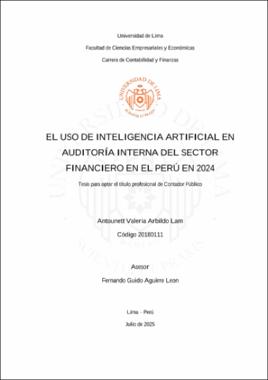
El uso de inteligencia artificial en auditoría interna del sector financiero en el Perú en 2024
| dc.contributor.advisor | Aguirre León, Fernando Guido | |
| dc.contributor.author | Arbildo Lam, Antounett Valeria | |
| dc.date.accessioned | 2025-09-23T16:32:19Z | |
| dc.date.available | 2025-09-23T16:32:19Z | |
| dc.date.issued | 2025 | |
| dc.identifier.uri | https://hdl.handle.net/20.500.12724/23383 | |
| dc.description.abstract | La presente investigación tiene como objetivo analizar la influencia del uso de inteligencia artificial en el trabajo de auditoría interna en el sector financiero peruano. Ante la llegada de un nuevo fenómeno digital que ha cambiado por completo los procesos organizacionales, el nuevo reto es adaptarse y seguir creciendo. Más aún, en un sector tan dinámico, importante y regulado como lo es el sector financiero. Bajo un enfoque cualitativo, se realizaron entrevistas semiestructuradas a auditores internos líderes en sus equipos de organizaciones financieras en el Perú, con la finalidad de profundizar el tema de estudio. Por otro lado, la investigación también abordó el enfoque cuantitativo mediante la aplicación de un cuestionario estructurado a miembros del equipo de auditoría interna del sector mencionado. Además, el análisis temático también incluyó investigaciones y publicaciones de fuentes académicas y especializadas. Los resultados evidenciaron que la implementación de la inteligencia artificial tuvo un impacto positivo en las áreas de auditoría interna de la banca peruana, mediante la mejora de eficiencia en procesos operativos del desarrollo de auditorías, como la mejora en detección e identificación de riesgos, optimizar la toma de decisiones, elaboración de informes de auditoría, entre muchos más. Asimismo, los auditores evaluados manifestaron una transformación en el rol profesional del auditor dentro de las organizaciones y que la llegada de la inteligencia artificial representa una oportunidad. No obstante, se revelaron también los desafíos y barreras que esta adopción ha traído consigo, como, por ejemplo: limitaciones presupuestales, falta de capacitación profesional, resistencia al cambio, etc. Se concluye que la inteligencia artificial influye positivamente en el trabajo de auditoría interna porque brinda soporte en actividades que permiten que el auditor se enfoque en el lado analítico y estratega de su función. | es_PE |
| dc.description.abstract | This research aims to analyze the influence of artificial intelligence (AI) on internal audit work in the Peruvian financial sector. With the emergence of a new digital phenomenon that has transformed organizational processes, the main challenge now is to adapt and continue evolving, especially in a dynamic, highly regulated, and strategic sector like finance. A qualitative approach was employed through semi-structured interviews with internal audit leaders from major financial organizations in Peru, aiming to gain deeper insights into the topic. Additionally, the study incorporated a quantitative approach via structured questionnaires applied to members of internal audit teams in the same sector. Thematic analysis also included academic and specialized publications. The results showed that the implementation of AI has had a positive impact on internal audit functions within Peruvian banking institutions, improving efficiency in audit processes such as risk identification, decision-making, and report preparation. Auditors also reported a transformation in their professional roles, recognizing AI as a strategic opportunity. However, challenges such as budget constraints, lack of professional training, and resistance to change were also identified. It is concluded that AI positively influences internal audit work by supporting tasks that allow auditors to focus on the analytical and strategic aspects of their function. | en_EN |
| dc.format | application/pdf | |
| dc.language.iso | spa | |
| dc.publisher | Universidad de Lima | |
| dc.rights | info:eu-repo/semantics/openAccess | |
| dc.rights.uri | https://creativecommons.org/licenses/by-nc-sa/4.0/ | * |
| dc.subject | Inteligencia artificial | es_PE |
| dc.subject | Control interno | es_PE |
| dc.subject | Empresas financieras | es_PE |
| dc.title | El uso de inteligencia artificial en auditoría interna del sector financiero en el Perú en 2024 | es_PE |
| dc.title.alternative | The use of artificial intelligence in internal audit of the financial sector in Peru in 2024 | en_EN |
| dc.type | info:eu-repo/semantics/bachelorThesis | |
| thesis.degree.level | Título profesional | |
| thesis.degree.discipline | Contabilidad y Finanzas | es_PE |
| thesis.degree.grantor | Universidad de Lima. Facultad de Ciencias Empresariales y Económicas | |
| dc.publisher.country | PE | |
| dc.type.other | Tesis | |
| thesis.degree.name | Contador Público | |
| renati.advisor.orcid | https://orcid.org/0000-0002-1327-8971 | |
| renati.discipline | 411026 | |
| dc.identifier.isni | 0000000121541816 | |
| renati.author.dni | 73973457 | |
| renati.level | https://purl.org/pe-repo/renati/level#tituloProfesional | * |
| renati.advisor.dni | 10470206 | |
| renati.juror | Fukunaga Fuentes, Fernando | |
| renati.juror | Noriega Ruiz, Luis Felipe | |
| renati.juror | Aguirre León, Fernando Guido | |
| renati.type | https://purl.org/pe-repo/renati/type#tesis | * |
| dc.subject.ocde | https://purl.org/pe-repo/ocde/ford#5.02.04 | |
| ulima.cat | 009 |
Files in this item


This item appears in the following Collection(s)
-
Tesis [12]

Except where otherwise noted, this item's license is described as info:eu-repo/semantics/openAccess