
Mostrar el registro sencillo del ítem
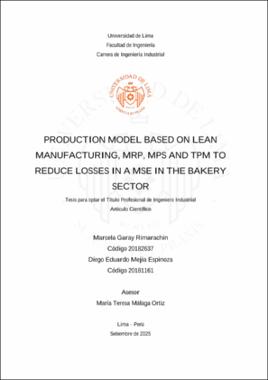
Production model based on lean manufacturing, MRP, MPS and TPM to reduce losses in a MSE in the bakery sector
| dc.contributor.advisor | Málaga Ortiz, María Teresa | |
| dc.contributor.author | Garay Rimarachin, Marcela | |
| dc.contributor.author | Mejia Espinoza, Diego Eduardo | |
| dc.date.accessioned | 2025-11-18T21:44:56Z | |
| dc.date.available | 2025-11-18T21:44:56Z | |
| dc.date.issued | 2025 | |
| dc.identifier.uri | https://hdl.handle.net/20.500.12724/23532 | |
| dc.description.abstract | Currently, the bakery sector has been growing exponentially, which is why most customers are more demanding and seek higher quality products. A large percentage of bakery companies in Peru are small or medium sized, most of which are in the informal sector. Because of this, they have inefficiencies in their processes that directly affect the final product causing deficiencies in these. That is why this research is based on reducing defective products by applying the Lean Manufacturing philosophy. The tools that were applied are the 5s, improvement of order and cleanliness within the plant; followed by the MRP to manage the stock of materials and then the MPS, to determine the amount of products to be produced and at what time they should be produced. Finally, the TPM, which ensures that each operator performs maintenance on the machines they use. This proposal was carried out by means of a pilot test in order to develop each tool in a bakery MSE. As a result, the following results were obtained: The reduction of finished products from 10% to 5%, reduction of production costs, and a reduction in the cost of production. | en_EN |
| dc.description.abstract | En la actualidad, el sector panadero ha estado creciendo exponencialmente, es por esto por lo que la mayoría de los clientes son más exigentes y buscan productos con una mayor calidad. Un gran porcentaje de empresas panaderas en el Perú son pequeñas o medianas de las cuales la mayoría están inducidas a la informalidad. Debido a esto cuentan con ineficiencias en sus procesos que afectan directamente al producto final ocasionando deficiencias de estos. Es por ello que la presente investigación se basa en reducir los productos defectuosos aplicando la filosofía de Lean Manufacturing. Las herramientas que fueron aplicadas son las 5s, mejora de orden y limpieza dentro de la planta; seguido de esto se aplicó el MRP para poder gestionar el stock de los materiales y luego el MPS, para poder determinar la cantidad de productos a producirse y en qué momento se deben elaborar. Finalmente, el TPM el cual se encarga de que cada operario haga mantenimiento de las maquinas que ellos emplean. Esta propuesta se llevó a cabo por medio de una prueba piloto para poder desarrollar cada herramienta en una MYPE de panificación. De esto modo se obtuvo como resultado: La reducción de productos terminados de 10% a 5%, disminución de costos de producción. | es_PE |
| dc.format | application/pdf | |
| dc.language.iso | eng | |
| dc.publisher | Universidad de Lima | |
| dc.rights | info:eu-repo/semantics/openAccess | |
| dc.rights.uri | https://creativecommons.org/licenses/by-nc-sa/4.0/ | * |
| dc.subject | Pendiente | es_PE |
| dc.title | Production model based on lean manufacturing, MRP, MPS and TPM to reduce losses in a MSE in the bakery sector | en_EN |
| dc.type | info:eu-repo/semantics/bachelorThesis | |
| thesis.degree.level | Título profesional | |
| thesis.degree.discipline | Ingeniería Industrial | |
| thesis.degree.grantor | Universidad de Lima. Facultad de Ingeniería | |
| dc.publisher.country | PE | |
| dc.type.other | Tesis | |
| thesis.degree.name | Ingeniero Industrial | |
| renati.advisor.orcid | https://orcid.org/0000-0002-5387-900X | |
| renati.discipline | 722026 | |
| dc.identifier.isni | 0000000121541816 | |
| renati.author.dni | 72207341 | |
| renati.author.dni | 72472687 | |
| renati.level | https://purl.org/pe-repo/renati/level#tituloProfesional | |
| renati.advisor.dni | 40121843 | |
| renati.juror | Santos Figueroa, Luis Enrique | |
| renati.juror | Tupia de la Cruz, Elmer Luis | |
| renati.juror | Málaga Ortiz, María Teresa | |
| renati.type | https://purl.org/pe-repo/renati/type#tesis | |
| dc.subject.ocde | https://purl.org/pe-repo/ocde/ford#2.11.04 | |
| ulima.cat | OI |
Ficheros en el ítem


Este ítem aparece en la(s) siguiente(s) colección(ones)
-
Tesis [1236]

Excepto si se señala otra cosa, la licencia del ítem se describe como info:eu-repo/semantics/openAccess