
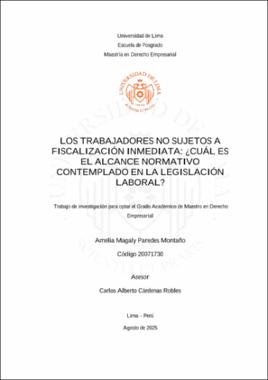
Los trabajadores no sujetos a fiscalización inmediata: ¿cuál es el alcance normativo contemplado en la legislación laboral?
| dc.contributor.advisor | Cárdenas Robles, Carlos Alberto Víctor Roberto | |
| dc.contributor.author | Paredes Montaño, Amelia Magaly | |
| dc.date.accessioned | 2025-11-18T21:45:39Z | |
| dc.date.available | 2025-11-18T21:45:39Z | |
| dc.date.issued | 2025 | |
| dc.identifier.uri | https://hdl.handle.net/20.500.12724/23582 | |
| dc.description.abstract | La jornada máxima laboral constituye uno de los aspectos de mayor relevancia para los trabajadores, ubicándose inmediatamente después de la remuneración en términos de importancia. De este modo, vemos que el tiempo de trabajo no solo determina la duración del servicio prestado, sino también el período disponible para actividades personales. En el marco del ordenamiento jurídico, la Constitución Política del Perú establece límites precisos respecto a la jornada laboral diaria y semanal. Sin embargo, el Texto Único Ordenado del Decreto Legislativo N.º 854 reconoce la existencia de determinados supuestos en los cuales ciertos trabajadores no se encuentran comprendidos dentro del régimen de la jornada máxima, quedando excluidos de dicho beneficio por la naturaleza de sus funciones o las características de la prestación laboral. En esa línea, se establecen criterios para identificar a los trabajadores excluidos, entre ellos, los trabajadores no sujetos a fiscalización inmediata, quienes desarrollan sus funciones sin supervisión directa del empleador. No obstante, como se verá más adelante, la norma no delimita con precisión los alcances de esta categoría, lo que plantea interrogantes relevantes para su aplicación. Esta ambigüedad normativa constituye el punto de partida de la presente investigación, en tanto una interpretación amplia del supuesto podría permitir al empleador calificar de manera arbitraria a determinados trabajadores, excluyéndolos de los beneficios vinculados a la jornada máxima legal. En los capítulos que siguen, se procederá al análisis detallado de la problemática previamente expuesta, con el objeto de formular una propuesta normativa orientada a esclarecer el marco jurídico aplicable. Para ello, se empleará un enfoque metodológico de carácter deductivo-analítico a través de una mirada integral del ordenamiento jurídico nacional y comparado. | es_PE |
| dc.description.abstract | The maximum working day is one of the most important aspects for workers, ranking immediately after remuneration in terms of importance. Indeed, working time determines not only the duration of service rendered but also the time available for personal activities. Within the framework of the legal system, the Peruvian Political Constitution establishes precise limits regarding daily and weekly working hours. However, the Consolidated Text of Legislative Decree No. 854 recognizes the existence of certain situations in which certain workers are not included within the maximum working day regime, being excluded from said benefit due to the nature of their duties or the characteristics of their work. Along these lines, criteria are established to identify workers excluded from the maximum workday regime, including workers not subject to immediate oversight, who perform their duties without direct employer supervision. However, the law does not precisely define the scope of this category, which raises significant questions regarding its application. This regulatory ambiguity constitutes the starting point for this research, as a broad interpretation of the assumption could allow employers to arbitrarily classify certain workers, excluding them from the benefits associated with the legal maximum workday. In the following chapters, we will conduct a detailed analysis of the aforementioned issues, with the aim of formulating a regulatory proposal aimed at clarifying the applicable legal framework. To this end, we will employ a deductive-analytical methodological approach through a comprehensive review of the national and comparative legal system. | en_EN |
| dc.format | application/pdf | |
| dc.language.iso | spa | |
| dc.publisher | Universidad de Lima | |
| dc.rights | info:eu-repo/semantics/openAccess | |
| dc.rights.uri | https://creativecommons.org/licenses/by-nc-sa/4.0/ | * |
| dc.title | Los trabajadores no sujetos a fiscalización inmediata: ¿cuál es el alcance normativo contemplado en la legislación laboral? | es_PE |
| dc.title.alternative | Workers not subject to immediate supervision: ¿what is the regulatory scope contemplated in labor legislation? | en_EN |
| dc.type | info:eu-repo/semantics/masterThesis | |
| thesis.degree.level | Maestría | |
| thesis.degree.discipline | Derecho Empresarial | |
| thesis.degree.grantor | Universidad de Lima. Escuela de Posgrado | |
| dc.publisher.country | PE | |
| dc.type.other | Trabajo de investigación | |
| thesis.degree.name | Maestro en Derecho Empresarial | |
| renati.discipline | 422167 | |
| dc.identifier.isni | 0000000121541816 | |
| renati.author.dni | 46068046 | |
| renati.level | https://purl.org/pe-repo/renati/level#maestro | |
| renati.advisor.dni | 06793872 | |
| renati.juror | Tuesta Silva, Wilder | |
| renati.juror | Ruíz Martínez, Marco Antonio | |
| renati.type | https://purl.org/pe-repo/renati/type#trabajoDeInvestigacion | |
| dc.subject.ocde | https://purl.org/pe-repo/ocde/ford#5.05.00 | |
| ulima.cat | OI |
Files in this item


This item appears in the following Collection(s)

Except where otherwise noted, this item's license is described as info:eu-repo/semantics/openAccess