
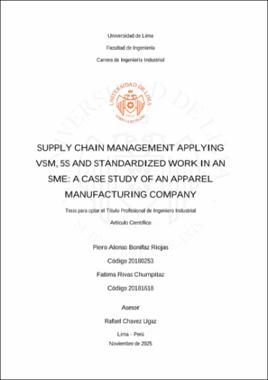
Supply chain management applying VSM, 5S and standardized work in an SME: a case study of an apparel manufacturing company
| dc.contributor.advisor | Chávez Ugáz, Rafael | |
| dc.contributor.author | Bonifaz Riojas, Piero Alonso | |
| dc.contributor.author | Rivas Chumpitaz, Fátima | |
| dc.date.accessioned | 2026-01-26T20:43:00Z | |
| dc.date.available | 2026-01-26T20:43:00Z | |
| dc.date.issued | 2025 | |
| dc.identifier.uri | https://hdl.handle.net/20.500.12724/24242 | |
| dc.description.abstract | Tras la pandemia por Covid-19 la industria de textil y confecciones se enfrenta a nuevos retos en los eslabones de la cadena textil debido a la incertidumbre global. Situando la mirada en Perú, la competitividad del sector se ve amenazada por las importaciones, las cuales reducen considerablemente la participación en el mercado de las MYPEs. La investigación tiene como objetivo optimizar la gestión de la Cadena de Suministro de una MYPE peruana del rubro textil, cuyos indicadores clave presentan un resultado menor al ideal del mercado. Ante esta situación también se propone la siguiente pregunta de investigación: ¿Cuáles son los beneficios de la aplicación de un modelo de gestión en la cadena de suministro que integre las herramientas VSM, 5S y Trabajo Estandarizado en el rubro textil de confecciones?, a la cual se busca dar respuesta. Esta investigación es de alcance explicativo en virtud de la búsqueda del porqué del bajo rendimiento inicial en los indicadores al realizar un diagnóstico del desempeño, y es de tipo cuasi experimental, donde tanto la empresa como las muestras de eventos no se seleccionan de forma aleatoria. Se propone la implementación de un modelo de gestión que integre herramientas Lean VSM, 5S y Trabajo Estandarizado en conjunto con planeamiento de la producción en la Cadena de Suministro de la empresa. La herramienta 5S se aplica al eslabón de producción dentro de la Cadena de Suministro al ser una filosofía centrada en la eliminación de desperdicios; mientras que en el resto de los eslabones se emplea VSM y Trabajo Estandarizado con el objetivo de definir un procedimiento estándar. El diseño de la metodología implica realizar un diagnóstico inicial de la empresa y se evalúa el resultado del modelo propuesto a través de la implementación de una prueba piloto. Como resultado de la implementación de la propuesta se logra obtener en la empresa mejoras considerables con relación a la productividad, generación de desperdicios, Lead Time y Value Added Ratio; estos son indicadores clave que reflejan la efectividad del modelo propuesto en una MYPE del sector textil en el Perú. Adicionalmente se realiza una evaluación económica cuantificando las mejoras, para posteriormente realizar una evaluación de escenarios con el fin de proyectar los resultados. | es_PE |
| dc.description.abstract | After the Covid-19 pandemic, the textile and apparel industry is facing new challenges in the links of the textile chain due to global uncertainties. In Peru, the competitiveness of the sector is threatened by imports, which significantly reduce the market share of MSEs. The research aims to optimise the supply chain management of a Peruvian MSE in the textile industry, whose key indicators show a lower performance than the market ideal. Given this situation, the following research question is also proposed What are the benefits of applying a supply chain management model that integrates VSM, 5S and Standardized Work tools in the apparel textile industry, to which we seek to provide an answer. This research is of an explanatory nature, since it seeks the reason for the initial low performance of the indicators in the performance diagnosis, and it is of a quasi-experimental type, in which both the company and the event samples are not selected randomly. The implementation of a management model that integrates VSM, 5S and Standardized Work tools in conjunction with production planning in the company's supply chain is proposed. The 5S tool is applied to the production stage of the supply chain, as it is a philosophy focused on eliminating waste, while VSM and Standardised Work are applied to the remaining stages with the aim of defining a standard procedure. The design of the methodology involves an initial diagnosis of the company, and the result of the proposed model is evaluated through the implementation of a pilot test. As a result of the implementation of the proposal, significant improvements are obtained in the company in terms of productivity, waste generation, lead time and value added ratio; these are key indicators that reflect the effectiveness of the proposed model in an MSE of the textile sector in Peru. In addition, an economic evaluation is carried out that quantifies the improvements in order to later carry out a scenario evaluation to project the results. | en_EN |
| dc.format | application/pdf | |
| dc.language.iso | spa | |
| dc.publisher | Universidad de Lima | |
| dc.rights | info:eu-repo/semantics/openAccess | * |
| dc.rights.uri | https://creativecommons.org/licenses/by-nc-sa/4.0/ | * |
| dc.subject | Pendiente | es_PE |
| dc.title | Supply chain management applying VSM, 5S and standardized work in an SME: a case study of an apparel manufacturing company | en_EN |
| dc.type | https://purl.org/coar/resource_type/c_7a1f | |
| thesis.degree.level | Titulo profesional | |
| thesis.degree.discipline | Ingeniería Industrial | |
| thesis.degree.grantor | Universidad de Lima. Facultad de Ingeniería | |
| dc.publisher.country | PE | |
| dc.type.other | Tesis | |
| thesis.degree.name | Ingeniero Industrial | |
| renati.advisor.orcid | https://orcid.org/0000-0002-9450-0158 | |
| renati.discipline | 722026 | |
| dc.identifier.isni | 0000000121541816 | |
| renati.author.dni | 71454941 | |
| renati.author.dni | 72622303 | |
| renati.level | https://purl.org/pe-repo/renati/level#tituloProfesional | |
| renati.advisor.dni | 09539644 | |
| renati.juror | Taquía Gutiérrez, José Antonio | |
| renati.juror | Urbina Rivera, Carlos Medardo | |
| renati.type | https://purl.org/pe-repo/renati/type#tesis | |
| dc.subject.ocde | https://purl.org/pe-repo/ocde/ford#2.11.04 | |
| ulima.cat | OI |
Files in this item


This item appears in the following Collection(s)
-
Tesis [1236]

Except where otherwise noted, this item's license is described as info:eu-repo/semantics/openAccess