
Mostrar el registro sencillo del ítem
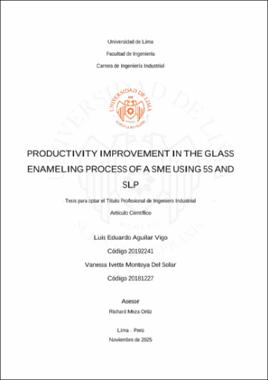
Productivity improvement in the glass enameling process of a SME using 5S and SLP
| dc.contributor.advisor | Meza Ortiz, Richard Nicholas | |
| dc.contributor.author | Aguilar Vigo, Luis Eduardo | |
| dc.contributor.author | Montoya Del Solar, Vanessa Ivette | |
| dc.date.accessioned | 2026-01-26T20:43:01Z | |
| dc.date.available | 2026-01-26T20:43:01Z | |
| dc.date.issued | 2025 | |
| dc.identifier.uri | https://hdl.handle.net/20.500.12724/24251 | |
| dc.description.abstract | Este estudio tuvo como objetivo aumentar la productividad del proceso de esmaltado en una empresa video vidrio mediante la eliminación de desperdicios (defectos, inventario, sobreprocesamiento, esperas y movimientos innecesarios) mediante la implementación de las 5S y SLP (Planificación Sistemática del Diseño). Se seleccionó una PYME (Pequeña y Mediana Empresa) dedicada a la fabricación de vidrio para carrocería y arquitectónico, que al inicio de la investigación presentaba una productividad de 0,88 HH/und. La metodología de investigación se basó en la metodología DMAIC (definir, medir, analizar, implementar, controlar) e incluyó técnicas de recolección de datos, análisis de procesos y revisión de indicadores. Los resultados mostraron un aumento del 51,24% en la productividad del proceso de esmaltado, lo que confirma que las herramientas utilizadas lograron eliminar actividades que consumen recursos y no agregan valor al proceso. Los hallazgos de esta investigación son relevantes para los gerentes de pequeñas y medianas empresas, ya que les brindan información útil para la toma de decisiones relacionadas con la inversión y asignación de recursos destinados a aumentar la productividad de sus propios procesos. Una de las limitaciones radica en el presupuesto disponible para la implementación del proyecto, ya que se sabe que otras herramientas y técnicas son más costosas. La implementación exitosa de las 5S puede requerir recursos financieros, de tiempo y de personal, y si la organización no asigna suficientes recursos para llevar a cabo el proyecto, es probable que enfrente obstáculos en el camino. | es_PE |
| dc.description.abstract | This study aimed to increase the productivity of the glazing process in a glass company by eliminating waste (defects, inventory, over-processing, waiting and unnecessary movements) through 5S and SLP (Systematic Layout Planning) implementation. An SME (Small and Medium-sized Enterprise) dedicated to the manufacture of bodywork and architectural glass was chosen, which at the beginning of the research had a productivity of 0.88 HH/und. The research methodology was based on the DMAIC methodology (define, measure, analyze, implement, control) and included data collection techniques, process analysis and review of indicators. The results showed a 51.24% increase in the productivity of the enameling process, confirming that the tools used were able to eliminate activities that consume resources and do not add value to the process. The findings of this research are relevant for managers of small and medium-sized enterprises, since they provide them with useful information for making decisions related to the investment and allocation of resources aimed at increasing the productivity of their own processes. One of the limitations is based on the economic budget available for the implementation of the project, since other tools and techniques are known to be more expensive. Successful implementation of 5S may require financial, time and personnel resources, and if the organization does not allocate sufficient resources to carry out the project, it is likely to face obstacles along the way. | en_EN |
| dc.format | application/pdf | |
| dc.language.iso | spa | |
| dc.publisher | Universidad de Lima | |
| dc.rights | info:eu-repo/semantics/openAccess | * |
| dc.rights.uri | https://creativecommons.org/licenses/by-nc-sa/4.0/ | * |
| dc.subject | Productividad industrial | es_PE |
| dc.subject | Producción eficiente | es_PE |
| dc.subject | Minimización de residuos | es_PE |
| dc.subject | Administración de instalaciones | es_PE |
| dc.subject | Revestimientos | es_PE |
| dc.title | Productivity improvement in the glass enameling process of a SME using 5S and SLP | en_EN |
| dc.type | https://purl.org/coar/resource_type/c_7a1f | |
| thesis.degree.level | Titulo profesional | |
| thesis.degree.discipline | Ingeniería Industrial | |
| thesis.degree.grantor | Universidad de Lima. Facultad de Ingeniería | |
| dc.publisher.country | PE | |
| dc.type.other | Tesis | |
| thesis.degree.name | Ingeniero Industrial | |
| renati.advisor.orcid | https://orcid.org/0000-0002-9490-2130 | |
| renati.discipline | 722026 | |
| dc.identifier.isni | 0000000121541816 | |
| renati.author.dni | 72972287 | |
| renati.author.dni | 72191887 | |
| renati.level | https://purl.org/pe-repo/renati/level#tituloProfesional | |
| renati.advisor.dni | 42694471 | |
| renati.juror | Horna Noriega, Luis Alberto | |
| renati.juror | Sánchez Soto, Paul Angello Daniel | |
| renati.type | https://purl.org/pe-repo/renati/type#tesis | |
| dc.subject.ocde | https://purl.org/pe-repo/ocde/ford#2.11.04 | |
| ulima.cat | 015 |
Ficheros en el ítem


Este ítem aparece en la(s) siguiente(s) colección(ones)
-
Tesis [1236]

Excepto si se señala otra cosa, la licencia del ítem se describe como info:eu-repo/semantics/openAccess