
Mostrar el registro sencillo del ítem
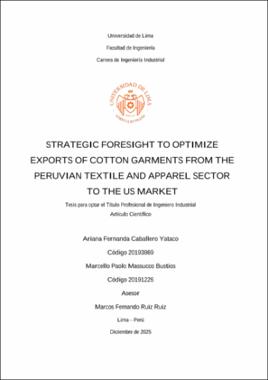
Strategic foresight to optimize exports of cotton garments from the peruvian textile and apparel sector to the us market
| dc.contributor.advisor | Ruiz Ruiz, Marcos Fernando | |
| dc.contributor.author | Caballero Yataco, Ariana Fernanda | |
| dc.contributor.author | Massucco Bustios, Marcello Paolo | |
| dc.date.accessioned | 2026-01-26T20:43:04Z | |
| dc.date.available | 2026-01-26T20:43:04Z | |
| dc.date.issued | 2025 | |
| dc.identifier.uri | https://hdl.handle.net/20.500.12724/24267 | |
| dc.description.abstract | El objetivo de esta investigación fue analizar prospectivamente las exportaciones del sector textil y confecciones peruano hacia el mercado de Estados Unidos para el año 2030. A través de este análisis se identificó un escenario apuesta, con proyecciones estratégicas que apuntan a un incremento anual de al menos un 5% en la participación de las prendas de algodón peruanas. La investigación empleó un diseño no experimental de alcance descriptivo y propositivo, integrando un análisis estructural mediante la herramienta MICMAC, que busca el consenso de expertos del sector y permitió identificar cuatro factores clave: informalidad, inversión en I+D, uso de la capacidad de producción instalada y atractivo del producto. Estos factores, en interacción con actores sociales clave (propietarios, entes gubernamentales y la Sociedad Nacional de Industrias), generan una sinergia estratégica. Adicionalmente, se utilizó el software SMIC-Prob para la creación de escenarios futuros. Los principales hallazgos indican que la implementación de las propuestas generaría un incremento del 25.42% en el monto total de exportaciones a EE.UU. en prendas de algodón, además de fomentar un crecimiento sostenible del sector mediante la producción más limpia y la optimización de rutas logísticas. Este estudio aporta al sector un enfoque prospectivo como herramienta para la toma de decisiones estratégicas, facilitando una comprensión más profunda de los efectos de factores económicos y sociales en la competitividad industrial. Las líneas de investigación futuras incluyen la replicabilidad del modelo en sectores similares y el desarrollo de estudios comparativos internacionales. | es_PE |
| dc.description.abstract | The objective of this research was to analyze the exports of Peruvian textile and clothing sector to the United States market for the year 2030. This analysis identified a target scenario, outlining strategic projections that forecast an annual growth of at least 5% in the market share of Peruvian cotton garments. The study employed a non-experimental design with a descriptive and propositional scope, incorporating structural analysis through the MICMAC tool. This method, which relies on expert consensus within the sector, identified four key factors: informality, investment in R&D, utilization of installed production capacity, and product attractiveness. These factors, when interacting with key social actors—such as business owners, government entities, and the National Society of Industries—generate strategic synergies. Additionally, SMIC-Prob software was used to construct future scenarios. The main findings suggest that implementing the proposed strategies could result in a 25.42% increase in the total export value of cotton garments to the U.S., while fostering sustainable growth in the sector through cleaner production practices and optimized logistics routes. This study provides the sector with a prospective framework as a strategic decision-making tool, offering deeper insights into the effects of economic and social factors on industrial competitiveness. Future research directions include applying the model to similar sectors and conducting international comparative studies. | en_EN |
| dc.format | application/pdf | |
| dc.language.iso | spa | |
| dc.publisher | Universidad de Lima | |
| dc.rights | info:eu-repo/semantics/openAccess | * |
| dc.rights.uri | https://creativecommons.org/licenses/by-nc-sa/4.0/ | * |
| dc.subject | Pendiente | es_PE |
| dc.title | Strategic foresight to optimize exports of cotton garments from the peruvian textile and apparel sector to the us market | en_EN |
| dc.type | https://purl.org/coar/resource_type/c_7a1f | |
| thesis.degree.level | Titulo profesional | |
| thesis.degree.discipline | Ingeniería Industrial | |
| thesis.degree.grantor | Universidad de Lima. Facultad de Ingeniería | |
| dc.publisher.country | PE | |
| dc.type.other | Tesis | |
| thesis.degree.name | Ingeniero Industrial | |
| renati.advisor.orcid | https://orcid.org/0000-0001-5147-8512 | |
| renati.discipline | 722026 | |
| dc.identifier.isni | 0000000121541816 | |
| renati.author.dni | 73176190 | |
| renati.author.dni | 75326354 | |
| renati.level | https://purl.org/pe-repo/renati/level#tituloProfesional | |
| renati.advisor.dni | 10002505 | |
| renati.juror | Quiroz Flores, Juan Carlos | |
| renati.juror | Noriega Araníbar, María Teresa | |
| renati.type | https://purl.org/pe-repo/renati/type#tesis | |
| dc.subject.ocde | https://purl.org/pe-repo/ocde/ford#2.11.04 | |
| ulima.cat | OI |
Ficheros en el ítem


Este ítem aparece en la(s) siguiente(s) colección(ones)
-
Tesis [1236]

Excepto si se señala otra cosa, la licencia del ítem se describe como info:eu-repo/semantics/openAccess