
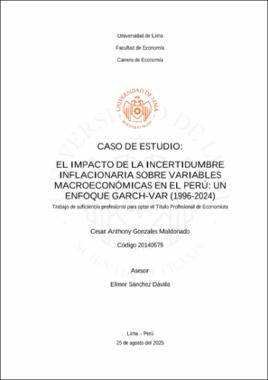
Caso de estudio: el impacto de la incertidumbre inflacionaria sobre variables macroeconómicas en el Perú: un enfoque GARCH-VAR (1996-2024)
| dc.contributor.advisor | Sánchez Dávila, Elmer | |
| dc.contributor.author | Gonzales Maldonado, Cesar Anthony | |
| dc.date.accessioned | 2026-01-27T14:49:28Z | |
| dc.date.available | 2026-01-27T14:49:28Z | |
| dc.date.issued | 2025 | |
| dc.identifier.uri | https://hdl.handle.net/20.500.12724/24314 | |
| dc.description.abstract | Esta investigación analiza la relación entre la incertidumbre inflacionaria y el desempeño macroeconómico del Perú en el período 1996–2024. El estudio adopta un enfoque cuantitativo y explicativo, utilizando datos del Banco Central de Reserva del Perú (BCRP) y de la U.S. Energy Information Administration (EIA). La incertidumbre inflacionaria se estimó a través de un modelo GARCH aplicado a la inflación interanual del IPC sin alimentos y energía (core), cuya varianza condicional se incorporó como variable endógena en un modelo VAR junto con el crecimiento del PBI, la tasa de interés de política, el tipo de cambio nominal y la variación del precio internacional del petróleo. Los resultados muestran que los choques externos, en particular los del petróleo, incrementan significativamente la incertidumbre inflacionaria en el corto plazo, reflejando la vulnerabilidad de una economía pequeña y abierta como la peruana frente a shocks importados de costos. En contraste, la relación entre el tipo de cambio y la incertidumbre inflacionaria no fue estadísticamente significativa, lo que sugiere que el régimen de metas de inflación y la estabilidad cambiaria han mitigado este canal. Asimismo, la tasa de interés de política respondió de manera significativa a los episodios de mayor incertidumbre, evidenciando la reacción preventiva del BCRP para preservar la credibilidad monetaria. Finalmente, se encontró que la incertidumbre inflacionaria ejerce un efecto contractivo sobre el crecimiento económico, al desalentar la inversión y deteriorar la asignación de recursos. Estos hallazgos resaltan la importancia de mantener una política monetaria creíble y transparente que reduzca los efectos adversos de la incertidumbre, además de la necesidad de diversificar la estructura productiva para limitar la exposición a choques externos. | es_PE |
| dc.description.abstract | This research examines the relationship between inflation uncertainty and Peru’s macroeconomic performance over the period 1996–2024. The study follows a quantitative and explanatory approach, using data from the Central Reserve Bank of Peru (BCRP) and the U.S. Energy Information Administration (EIA). Inflation uncertainty is estimated through a GARCH model applied to year-on-year core CPI inflation, with its conditional variance incorporated as an endogenous variable into a VAR model together with GDP growth, the policy interest rate, the nominal exchange rate, and international oil price variation. The results indicate that external shocks, particularly those related to oil prices, significantly increase inflation uncertainty in the short run, highlighting the vulnerability of a small open economy like Peru to imported cost shocks. In contrast, the relationship between the exchange rate and inflation uncertainty was not statistically significant, suggesting that exchange rate stability and the inflation-targeting regime have mitigated this channel. Moreover, the policy interest rate responds significantly to periods of greater uncertainty, reflecting the proactive role of the Central Bank in preserving monetary credibility. Finally, inflation uncertainty is found to have a contractionary impact on economic growth by discouraging investment and reducing the efficiency of resource allocation. These findings emphasize the importance of maintaining a credible and transparent monetary policy to mitigate the adverse effects of uncertainty, as well as the need to diversify the productive structure to limit exposure to external shocks. | en_EN |
| dc.format | application/pdf | |
| dc.language.iso | spa | |
| dc.publisher | Universidad de Lima | |
| dc.rights | info:eu-repo/semantics/openAccess | |
| dc.rights.uri | https://creativecommons.org/licenses/by-nc-sa/4.0/ | * |
| dc.subject | Inflación | es_PE |
| dc.subject | Desarrollo económico | es_PE |
| dc.subject | Política monetaria | es_PE |
| dc.subject | Tipos de cambio | es_PE |
| dc.subject | Heterocedasticidad condicional autorregresiva | es_PE |
| dc.title | Caso de estudio: el impacto de la incertidumbre inflacionaria sobre variables macroeconómicas en el Perú: un enfoque GARCH-VAR (1996-2024) | es_PE |
| dc.type | https://purl.org/coar/resource_type/c_7a1f | |
| thesis.degree.level | Título profesional | |
| thesis.degree.discipline | Economía | |
| thesis.degree.grantor | Universidad de Lima. Facultad de Economía | |
| dc.publisher.country | PE | |
| dc.type.other | Trabajo de suficiencia profesional | |
| thesis.degree.name | Economista | |
| renati.advisor.orcid | https://orcid.org/0000-0003-3473-999X | |
| renati.discipline | 311016 | |
| dc.identifier.isni | 0000000121541816 | |
| renati.author.dni | 73889750 | |
| renati.level | https://purl.org/pe-repo/renati/level#tituloProfesional | |
| renati.advisor.dni | 70242424 | |
| renati.juror | Urbina Padilla, Dante Abelardo | |
| renati.juror | Rojas Cama, Freddy Arnaldo | |
| renati.juror | Sánchez Dávila, Elmer | |
| renati.type | https://purl.org/pe-repo/renati/type#trabajoDeSuficienciaProfesional | |
| dc.subject.ocde | https://purl.org/pe-repo/ocde/ford#5.02.01 | |
| ulima.lineadeinvestigacion | 5300 - 5.H1 | |
| ulima.cat | 015 |
Files in this item


This item appears in the following Collection(s)

Except where otherwise noted, this item's license is described as info:eu-repo/semantics/openAccess