
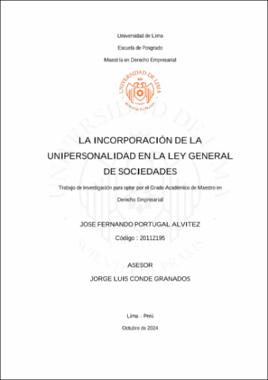
La incorporación de la unipersonalidad en la Ley General de Sociedades
| dc.contributor.advisor | Conde Granados, Jorge Luis | |
| dc.contributor.author | Portugal Alvitez, Jose Fernando | |
| dc.date.accessioned | 2026-03-05T15:38:38Z | |
| dc.date.available | 2026-03-05T15:38:38Z | |
| dc.date.issued | 2024 | |
| dc.identifier.uri | https://hdl.handle.net/20.500.12724/24534 | |
| dc.description.abstract | El presente trabajo, pretendía desarrollar los aspectos jurídicos de la introducción de las sociedades unipersonales en la Ley General de Sociedades. Con este objetivo, no se introduciría un nuevo modelo societario que contuviera su propia regulación en la materia, sino, la adaptación de la Ley General de Sociedades con el fin de permitir la unipersonalidad originaria y sobrevenida de las sociedades anónimas. Durante el desarrollo del trabajo de investigación se buscaba reconocer la realidad y trasladarla a la legislación, en el sentido, que las sociedades unipersonales ya están presentes tanto en nuestra legislación como en el mercado. En nuestra sociedad, el emprendimiento personal es la norma y las asociaciones son una opción, sin embargo, estas últimas cuentan con privilegios y ventajas que superan las dadas libremente por su naturaleza y el mercado, y cuentan con privilegios legislativos. Esto da lugar a una desventaja natural del comerciante individual que recurre a la informalidad, figuras jurídicas anticuadas como la EIRL y a la ficción jurídica de pluralidad, representada por las sociedades de favor. La investigación concluyo, que es posible, con relativamente pocos cambios y modificaciones menores, adaptar el modelo de sociedad anónima al desarrollo de la actividad económica unipersonal. Reconocimiento la tacita realidad, de las sociedades unipersonal sobrevenida, y originaria, surgidas de las sociedades de favor. Este cambio no desprender a la figura de su naturaleza asociativa, sino que, permitiría la opción de surgir o devenir en la unipersonalidad sin perjuicios; facilitando el acceso al mercado, sincerando la realidad y previniendo la desaparición de empresas económicamente activas. | es_PE |
| dc.description.abstract | The purpose of this work was to develop the legal aspects of the introduction of sole proprietorships in the General Corporations Law. With this objective, it would not introduce a new corporate model that would contain its own regulation on the matter, but rather, the adaptation of the General Corporations Law in order to allow the original and supervening unipersonality of corporations. During the development of the research work, the aim was to recognize the reality and transfer it to the legislation, in the sense that sole proprietorships are already present both in our legislation and in the market. In our society, personal entrepreneurship is the norm and partnerships are an option, however, the latter have privileges and advantages that exceed those freely given by their nature and the market, and have legislative privileges. This gives rise to a natural disadvantage of the sole trader who resorts to informality, antiquated legal figures such as the EIRL and the legal fiction of plurality, represented by the partnerships. The research concluded that it is possible, with relatively few changes and minor modifications, to adapt the corporation model to the development of sole proprietorship. Recognition of the tacit reality of supervening and original sole proprietorships, arising from partnerships. This change would not remove the figure from its associative nature, but would allow the option of arising or becoming a sole proprietorship without prejudice, facilitating access to the market, making the reality sincerer and preventing the disappearance of economically active companies. | en_EN |
| dc.format | application/pdf | |
| dc.language.iso | spa | |
| dc.publisher | Universidad de Lima | |
| dc.rights | https://purl.org/coar/access_right/c_abf2 | |
| dc.rights.uri | https://creativecommons.org/licenses/by-nc-sa/4.0/ | * |
| dc.title | La incorporación de la unipersonalidad en la Ley General de Sociedades | es_PE |
| dc.title.alternative | The incorporation of unipersonality in the General Company Law | en_EN |
| dc.type | https://purl.org/coar/resource_type/c_bdcc | |
| thesis.degree.level | Maestría | |
| thesis.degree.discipline | Derecho Empresarial | |
| thesis.degree.grantor | Universidad de Lima. Escuela de Posgrado | |
| dc.publisher.country | PE | |
| dc.type.other | Trabajo de investigación | |
| thesis.degree.name | Maestro en Derecho Empresarial | |
| renati.advisor.orcid | https://orcid.org/0000-0001-6734-3524 | |
| renati.discipline | 422167 | |
| dc.identifier.isni | 0000000121541816 | |
| renati.author.dni | 71227905 | |
| renati.level | https://purl.org/pe-repo/renati/level#maestro | |
| renati.advisor.dni | 10269932 | |
| renati.juror | Chamochumbi Calderón, Luis Eduardo | |
| renati.juror | Ruíz Martinez, Marco Antonio | |
| renati.juror | Conde Granados, Jorge Luis | |
| renati.type | https://purl.org/pe-repo/renati/type#trabajoDeInvestigacion | |
| dc.subject.ocde | https://purl.org/pe-repo/ocde/ford#5.05.00 | |
| ulima.cat | OI |
Files in this item


This item appears in the following Collection(s)

Except where otherwise noted, this item's license is described as https://purl.org/coar/access_right/c_abf2