
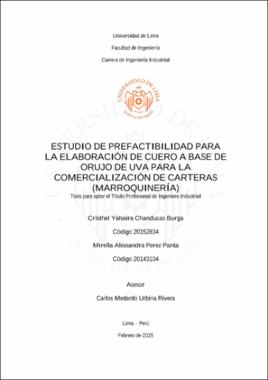
Estudio de prefactibilidad para la elaboración de cuero a base de orujo de uva para la comercialización de carteras (marroquinería)
View/
Tesis_Resumen
(application/pdf: 222.8Kb)
(application/pdf: 222.8Kb)
Tesis
(application/pdf: 4.085Mb)
(application/pdf: 4.085Mb)
Autorización
(application/pdf: 238.5Kb)
(application/pdf: 238.5Kb)
Reporte de similitud
(application/pdf: 5.954Mb)
(application/pdf: 5.954Mb)
Date
2025Metadata
Show full item recordAbstract
El objetivo principal de este proyecto de investigación es evaluar la viabilidad técnica, financiera, económica, social, medioambiental y de mercado para la elaboración de cuero del orujo de uva para la comercialización de carteras, las cuales tienen como objetivo de mercado a mujeres entre los 25 y 55 años de un NSE A/B de Lima Metropolitana.
Para conocer el público interesado en el producto, se realizó un estudio de mercado en el cual se encontró que la demanda del proyecto sería de 6 166 carteras para el año 2027.
También se determinó la mejor localización para la planta de producción a través de un ranking de factores, con el que se identificó que el mejor lugar sería en la provincia de Cañete en el distrito de San Vicente.
Luego se determinó el tamaño de la planta el cual resultó ser de 6166 carteras anuales como máximo. El recurso productivo limitante fue el de la demanda.
Se identificaron las actividades y equipos necesarios para la producción del cuero vegetal y se calculó la capacidad de planta determinada por el cuello de botella del proceso de producción que resultó ser 9386 carteras en la operación del fusionado.
La inversión total para el proyecto es de S/ 1 217 609, la cual estará financiada con el banco el 40% y el resto con capital propio. Además, se tiene que el VANE de S/ 513 802 y VANF de S/ 626 330 resultan mayores a 0. Por otro lado, el TIRE y TIRF tienen un valor de 32,75% y 43,25% respectivamente, los cuales son mayores al costo de oportunidad (19,58 %). El resultado de estos 4 indicadores refleja rentabilidad para el proyecto.
Por último, se afirma que el proyecto es técnica, financiera, económica, social, de mercado y medioambientalmente factible. The main objective of this research project is to evaluate the technical, financial, economic, social, environmental and market feasibility for the production of leather based on grape marc for the commercialization of handbags, which target market is women in the age range of 25 - 55 years of socioeconomic levels A/B from Metropolitan Lima.
A market study was carried out and found that the demand for the project would be 6,166 handbags by the year 2027.
The location for the production plant will take place in the province of Cañete in the district of San Vicente because of the availability of raw material, also it is close to the target market.
The equipment necessary as well as the activities of the project to carry out the production process of vegetable tanned leather was determined by the bottleneck of the production process which turned out to be 9 386 bags in the melting operation.
The total investment for the project is S/ 1 217 609, which will be financed with the bank in 40% and the rest with own capital. In addition, the NPV economic of S/ 513 802 and NPV financial of S/ 626 330 results more than 0. On the other hand, the IRR economic and financial have a value of 32,75% and 43,25% respectively, which are greater than the opportunity cost (19,58%). The result of these 4 indicators reflects profitability for the project.
Finally, it is stated that the project is technically, financially, economically, socially, marketably and environmentally feasible.
Publisher
Universidad de LimaSubject
Collections
- Tesis [1167]