
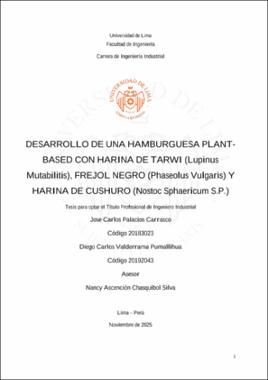
Desarrollo de una hamburguesa plant-based con harina de tarwi (Lupinus Mutabilitis), frejol negro (Phaseolus Vulgaris) y harina de cushuro (Nostoc sphaericum S.P.)
| dc.contributor.advisor | Chasquibol Silva, Nancy Ascención | |
| dc.contributor.author | Palacios Carrasco, Jose Carlos | |
| dc.contributor.author | Valderrama Pumallihua, Diego Carlos | |
| dc.date.accessioned | 2026-01-26T20:43:03Z | |
| dc.date.available | 2026-01-26T20:43:03Z | |
| dc.date.issued | 2025 | |
| dc.identifier.uri | https://hdl.handle.net/20.500.12724/24261 | |
| dc.description.abstract | La tendencia en el consumo de productos basados en fuentes vegetales va en aumento debido a la creciente preocupación por la sostenibilidad y los efectos ambientales de la producción de productos cárnicos. En este contexto, se elaboró una hamburguesa plant-based con alto contenido de proteína y un perfil balanceado de aminoácidos escenciales, combinando harina de tarwi (Lupinus mutabilis), frejol negro (Phaseolus vulgaris) y cushuro (Nostoc sphaericum). El tarwi es una leguminosa andina rica en proteínas (40-50%) y grasas saludables (20%), mientras que el frejol negro es una fuente importante de fibra y minerales. El cushuro, una cianobacteria altoandina, tiene un alto contenido proteico y minerales como hierro y calcio. Para la formulación de la hamburguesa plant-based, se mezclaron harina de tarwi (45%), harina de cushuro (2,33%), frejol negro (8,77%), zanahoria (3%), huevo (36%), sal de mara (0,85%), orégano en polvo (0,75%), páprika en polvo (1,4%), ajo molido (0,9%) y cebolla en polvo (1%). Los resultados mostraron que la muestra óptima (MO) presentó 30,48% de proteínas, 36,19% de humedad, 22,06% de grasa y 8,91% de carbohidratos, con un perfil equilibrado de aminoácidos, destacando el ácido glutámico (196,16 ± 4,77 mg/g proteína), arginina (145,91 ± 4,75 mg/g proteína), ácido aspártico (83,00 ± 4,52 mg/g proteína). Además, se obtuvo una actividad antioxidante de 1502,19 μg trolox/g, y en la evaluación sensorial la MO alcanzó una aceptabilidad del 86,67%, resaltando en sabor, textura y apariencia frente a la muestra de control, lo que demuestra su potencial como alternativa proteica sostenible y nutritiva. | es_PE |
| dc.description.abstract | The trend in the consumption of plant-based products is increasing due to the growing concern about the sustainability and environmental effects of meat product production. In this context, a plant-based hamburger with a high protein content and a balanced profile of essential amino acids was made, combining tarwi flour (Lupinus mutabilis), black bean (Phaseolus vulgaris) and cushuro (Nostoc sphaericum). Tarwi is an Andean legume rich in protein (40-50%) and healthy fats (20%), while black beans are an important source of fiber and minerals. The cushuro, a high Andean cyanobacterium, has a high protein content and minerals such as iron and calcium. For the formulation of the plant-based hamburger, tarwi flour (45%), cushuro flour (2.33%), black beans (8.77%), carrots (3%), eggs (36%), mara salt (0.85%), oregano powder (0.75%), paprika powder (1.4%), ground garlic (0.9%) and onion powder (1%) were mixed. The results showed that the optimal sample (OM) presented 30.48% protein, 36.19% moisture, 22.06% fat and 8.91% carbohydrates, with a balanced amino acid profile, highlighting glutamic acid (196.16 ± 4.77 mg/g protein), arginine (145.91 ± 4.75 mg/g protein), aspartic acid (83.00 ± 4.52 mg/g protein). In addition, an antioxidant activity of 1502.19 μg trolox/g was obtained, and in the sensory evaluation the OM reached an acceptability of 86.67%, standing out in flavor, texture and appearance compared to the control sample, which demonstrates its potential as a sustainable and nutritious protein alternative. | en_EN |
| dc.format | application/pdf | |
| dc.language.iso | spa | |
| dc.publisher | Universidad de Lima | |
| dc.rights | info:eu-repo/semantics/openAccess | * |
| dc.rights.uri | https://creativecommons.org/licenses/by-nc-sa/4.0/ | * |
| dc.subject | Pendiente | es_PE |
| dc.title | Desarrollo de una hamburguesa plant-based con harina de tarwi (Lupinus Mutabilitis), frejol negro (Phaseolus Vulgaris) y harina de cushuro (Nostoc sphaericum S.P.) | es_PE |
| dc.type | https://purl.org/coar/resource_type/c_7a1f | |
| thesis.degree.level | Titulo profesional | |
| thesis.degree.discipline | Ingeniería Industrial | |
| thesis.degree.grantor | Universidad de Lima. Facultad de Ingeniería | |
| dc.publisher.country | PE | |
| dc.type.other | Tesis | |
| thesis.degree.name | Ingeniero Industrial | |
| renati.advisor.orcid | https://orcid.org/0000-0002-9858-0431 | |
| renati.discipline | 722026 | |
| dc.identifier.isni | 0000000121541816 | |
| renati.author.dni | 73013037 | |
| renati.author.dni | 76956221 | |
| renati.level | https://purl.org/pe-repo/renati/level#tituloProfesional | |
| renati.advisor.dni | 08294713 | |
| renati.juror | Yácono Llanos, Juan Carlos | |
| renati.juror | Arroyo Benites, Edmundo Valdemar | |
| renati.type | https://purl.org/pe-repo/renati/type#tesis | |
| dc.subject.ocde | https://purl.org/pe-repo/ocde/ford#2.11.04 | |
| ulima.cat | OI |
Files in this item


This item appears in the following Collection(s)
-
Tesis [1236]

Except where otherwise noted, this item's license is described as info:eu-repo/semantics/openAccess