
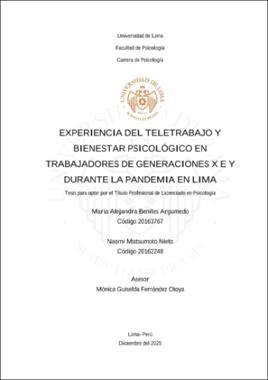
Experiencia del teletrabajo y bienestar psicológico en trabajadores de generaciones X e Y durante la pandemia en Lima
| dc.contributor.advisor | Fernández Otoya, Mónica Guiselda | |
| dc.contributor.author | Benites Argumedo, María Alejandra | |
| dc.contributor.author | Matsumoto Nieto, Naomi | |
| dc.date.accessioned | 2026-03-05T14:49:44Z | |
| dc.date.available | 2026-03-05T14:49:44Z | |
| dc.date.issued | 2025 | |
| dc.identifier.uri | https://hdl.handle.net/20.500.12724/24515 | |
| dc.description.abstract | La pandemia por Covid-19 representó un desafío complejo para toda la población, especialmente para los trabajadores, quienes enfrentaron un cambio abrupto hacia el teletrabajo en medio de la crisis sanitaria. Considerando la coexistencia de distintas generaciones en el mercado laboral y cómo sus características influyen en los procesos de adaptación, este estudio tuvo como objetivo explorar y diferenciar la experiencia de adaptación al teletrabajo en individuos de las generaciones X y Y en torno a su bienestar psicológico. Se desarrolló una investigación cualitativa, de enfoque fenomenológico y exploratorio, mediante entrevistas semiestructuradas aplicadas a doce participantes: seis de cada generación. Los resultados mostraron que los participantes de la generación X presentaron mayor resistencia al cambio, dificultades con herramientas digitales y malestar emocional, junto con una fuerte preferencia por retomar a la presencialidad, incluso a costa de su bienestar físico y psicológico. En contraste, los participantes de la generación Y mostraron una adaptación más flexible, identificando beneficios del teletrabajo y aplicando estrategias asociadas al crecimiento personal y la autonomía, dimensiones clave del bienestar psicológico. Ambos grupos experimentaron malestar emocional, problemas físicos y dificultades para establecer límites laborales; sin embargo, las diferencias generacionales influyeron significativamente en sus formas de afrontar y adaptarse a la nueva modalidad laboral. | es_PE |
| dc.description.abstract | The Covid-19 pandemic represented a complex challenge for the entire population, especially for workers, who faced an abrupt shift to teleworking amid the health crisis. Considering the coexistence of different generations in the labor market and how their characteristics influence adaptation processes, this study aimed to explore and differentiate the experience of adaptation to teleworking in individuals from generations X and Y according to their psychological well-being. A qualitative research, with a phenomenological and exploratory approach, was developed through semi-structured interviews applied to twelve participants: six from each generation. The results showed that participants from generation X presented greater resistance to change, difficulties with digital tools and emotional discomfort, along with a strong preference for returning to in-person work, even at the cost of their physical and psychological well-being. In contrast, participants from generation Y showed a more flexible adaptation, identifying benefits of teleworking and applying strategies associated with personal growth and autonomy, key dimensions of psychological well-being. Both groups experienced emotional discomfort, physical problems, and difficulties in establishing work boundaries; However, generational differences significantly influenced their ways of coping and adapting to the new work modality. | en_EN |
| dc.format | application/pdf | |
| dc.language.iso | spa | |
| dc.publisher | Universidad de Lima | |
| dc.rights | https://purl.org/coar/access_right/c_abf2 | |
| dc.rights.uri | https://creativecommons.org/licenses/by-nc-sa/4.0/ | * |
| dc.subject | Pendiente | es_PE |
| dc.title | Experiencia del teletrabajo y bienestar psicológico en trabajadores de generaciones X e Y durante la pandemia en Lima | es_PE |
| dc.title.alternative | Teleworking experience and psychological well-being in generations X and Y workers during the pandemic in Lima | en_EN |
| dc.type | info:eu-repo/semantics/bachelorThesis | |
| thesis.degree.level | Título profesional | |
| thesis.degree.discipline | Psicología | |
| thesis.degree.grantor | Universidad de Lima. Facultad de Psicología | |
| dc.publisher.country | PE | |
| dc.type.other | Tesis | |
| thesis.degree.name | Licenciado en Psicología | |
| renati.advisor.orcid | https://orcid.org/0009-0001-9395-8140 | |
| renati.discipline | 313016 | |
| dc.identifier.isni | 0000000121541816 | |
| renati.author.dni | 73238821 | |
| renati.author.dni | 72042100 | |
| renati.level | https://purl.org/pe-repo/renati/level#tituloProfesional | |
| renati.advisor.dni | 10874613 | |
| renati.juror | Flores Giles, Zoila Magaly | |
| renati.juror | Huertas Mantilla, Leonardo Percy | |
| renati.juror | Fernandez Otoya, Monica Guiselda | |
| renati.type | https://purl.org/pe-repo/renati/type#tesis | |
| dc.subject.ocde | https://purl.org/pe-repo/ocde/ford#5.01.00 | |
| ulima.cat | OI |
Files in this item


This item appears in the following Collection(s)
-
Tesis [169]

Except where otherwise noted, this item's license is described as https://purl.org/coar/access_right/c_abf2