
Mostrar el registro sencillo del ítem
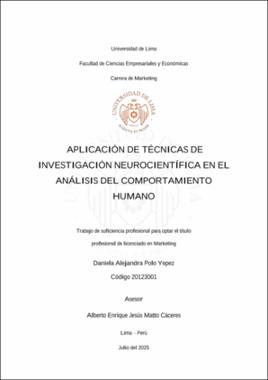
Aplicación de técnicas de investigación neurocientífica en el análisis del comportamiento humano
| dc.contributor.advisor | Matto Cáceres, Alberto Enrique Jesús | |
| dc.contributor.author | Polo Yepez, Daniela Alejandra | |
| dc.date.accessioned | 2025-09-23T16:32:13Z | |
| dc.date.available | 2025-09-23T16:32:13Z | |
| dc.date.issued | 2025 | |
| dc.identifier.uri | https://hdl.handle.net/20.500.12724/23345 | |
| dc.description.abstract | El mercado global de soluciones de neuromarketing muestra un crecimiento sólido y sostenido, respaldado por una Tasa de Crecimiento Anual Compuesta (CAGR) del 8.89 %. Partiendo de un valor de 1.54 mil millones de dólares en el 2024, se proyecta que el mercado alcance aproximadamente 2.62 mil millones para el 2030, evidenciando un interés creciente en las herramientas neurocientíficas; para analizar el comportamiento del consumidor. Aunque el cálculo técnico basado en la fórmula de interés compuesto estima un valor ligeramente menor (2.58 mil millones), esta diferencia puede atribuirse a factores como la innovación tecnológica, la diversificación de aplicaciones y la expansión a nuevos mercados. Esto confirma la viabilidad económica y el atractivo del sector para inversores y organizaciones que buscan optimizar sus estrategias mediante un enfoque científico. El neuromarketing representa una evolución en el entendimiento del consumidor al combinar neurociencia y marketing, permitiendo analizar emociones, motivaciones y decisiones que escapan a métodos tradicionales. Herramientas biométricas como eye tracking, EEG, GSR y facial coding han validado hipótesis sobre atención y memoria, mejorando la efectividad de las campañas publicitarias. Fundamentado en una visión interdisciplinaria del cerebro humano, el neuromarketing revela que gran parte de las decisiones se toman de forma inconsciente, aportando no solo valor comercial sino también científico (Kahneman, 2011; Plassmann et al., 2015). En el contexto peruano, establecer un laboratorio de neuromarketing presenta una oportunidad rentable a mediano plazo. A pesar de los costos iniciales elevados, la baja competencia local y el apoyo académico e institucional crean un ambiente favorable para el desarrollo de esta industria. Con un modelo de negocio bien estructurado, que incluya alianzas estratégicas y una oferta flexible, es posible lograr un retorno de inversión significativo en menos de tres años. Así, el neuromarketing se posiciona como un nicho empresarial emergente, con aplicación práctica y respaldo científico en el Perú. | es_PE |
| dc.description.abstract | The global neuromarketing solutions market is demonstrating solid and sustained growth, supported by a Compound Annual Growth Rate (CAGR) of 8.89%. Starting from a value of USD 1.54 billion in 2024, the market is projected to reach approximately USD 2.62 billion by 2030, reflecting a growing interest in neuroscientific tools for analyzing consumer behavior. Although the technical calculation based on the compound interest formula estimates a slightly lower value (USD 2.58 billion), this discrepancy can be attributed to factors such as technological innovation, diversification of applications, and expansion into new markets. This confirms the sector’s economic viability and its appeal to investors and organizations seeking to optimize their strategies through a scientific approach. Neuromarketing represents an evolution in understanding consumer behavior by combining neuroscience and marketing, enabling the analysis of emotions, motivations, and decisions that elude traditional methods. Biometric tools such as eye tracking, EEG, GSR, and facial coding have validated hypotheses related to attention and memory, thereby enhancing the effectiveness of advertising campaigns. Grounded in an interdisciplinary view of the human brain, neuromarketing reveals that a large portion of decisions are made unconsciously, offering not only commercial value but also scientific insight (Kahneman, 2011; Plassmann et al., 2015). In the Peruvian context, establishing a neuromarketing laboratory presents a profitable medium-term opportunity. Despite high initial costs, low local competition and strong academic and institutional support create a favorable environment for the development of this industry. With a well-structured business model—including strategic partnerships and a flexible service offering—it is possible to achieve a significant return on investment in under three years. Thus, neuromarketing is positioned as an emerging business niche in Peru, offering both practical application and scientific backing. | en_EN |
| dc.format | application/pdf | |
| dc.language.iso | spa | |
| dc.publisher | Universidad de Lima | |
| dc.rights | info:eu-repo/semantics/openAccess | |
| dc.rights.uri | https://creativecommons.org/licenses/by-nc-sa/4.0/ | * |
| dc.subject | Pendiente | es_PE |
| dc.title | Aplicación de técnicas de investigación neurocientífica en el análisis del comportamiento humano | es_PE |
| dc.type | info:eu-repo/semantics/bachelorThesis | |
| thesis.degree.level | Título profesional | |
| thesis.degree.discipline | Marketing | es_PE |
| thesis.degree.grantor | Universidad de Lima. Facultad de Ciencias Empresariales y Económicas | |
| dc.publisher.country | PE | |
| dc.type.other | Trabajo de suficiencia profesional | |
| thesis.degree.name | Licenciado en Marketing | |
| renati.advisor.orcid | https://orcid.org/0000-0002-1955-4471 | |
| renati.discipline | 414026 | |
| dc.identifier.isni | 0000000121541816 | |
| renati.author.dni | 47190723 | |
| renati.level | https://purl.org/pe-repo/renati/level#tituloProfesional | * |
| renati.advisor.dni | 08239584 | |
| renati.juror | Muente Urrunaga, Rodolfo Pedro | |
| renati.juror | Aguilar Iparraguirre, Claudia del Carmen | |
| renati.juror | Matto Cáceres, Alberto Enrique Jesús | |
| renati.type | https://purl.org/pe-repo/renati/type#trabajoDeSuficienciaProfesional | * |
| dc.subject.ocde | https://purl.org/pe-repo/ocde/ford#5.02.04 | |
| ulima.lineadeinvestigacion | 5205 - 3.j1 | |
| ulima.cat | OI |
Ficheros en el ítem


Este ítem aparece en la(s) siguiente(s) colección(ones)

Excepto si se señala otra cosa, la licencia del ítem se describe como info:eu-repo/semantics/openAccess