
Mostrar el registro sencillo del ítem
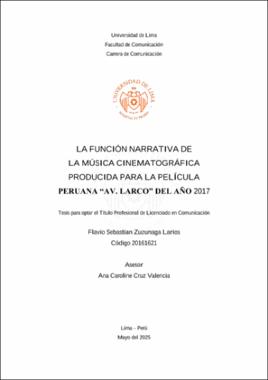
La función narrativa de la música cinematográfica producida para la película peruana "Av. Larco" del año 2017
| dc.contributor.advisor | Cruz Valencia, Ana Caroline | |
| dc.contributor.author | Zuzunaga Larios, Flavio Sebastian | |
| dc.date.accessioned | 2025-09-23T16:39:32Z | |
| dc.date.available | 2025-09-23T16:39:32Z | |
| dc.date.issued | 2025 | |
| dc.identifier.uri | https://hdl.handle.net/20.500.12724/23411 | |
| dc.description.abstract | La película “Av. Larco” es un musical de carácter documental que aborda un contexto histórico trágico peruano, que consideró a la música como un registro histórico y base principal para la escritura del guion, donde las canciones son el recurso narrativo que refuerza las emociones que la película busca comunicar. Este estudio tiene como objetivo analizar la relación entre la música cinematográfica y la imagen en una película, teniendo como caso de estudio la película Av. Larco, estrenada el año 2017. Fueron utilizados el análisis del modelo semiótico musical adaptado por Eero Tarasti y el estudio de caso a través del uso de entrevistas en profundidad a diferentes actores. Se concluye que la música en la película "Av. Larco" aportó significados al espectador integrándose de manera coherente con la narrativa visual y transformando las canciones originales para apoyar y maximizar el mensaje de la obra audivisual. Estos resultados evidencian que la música cinematográfica y las imágenes tienen una relación directa y efectiva al comunicar la historia presente en la película, así mismo que el cine musical tiene un efecto en la cultura moderna y al mismo tiempo puede usarse como herramienta para comprender la historia. | es_PE |
| dc.description.abstract | The film ‘Av. Larco’ is a documentary musical that deals with a tragic Peruvian historical context, which considered music as a historical record and the main basis for writing the script, where the songs are the narrative resource that reinforces the emotions that the film seeks to communicate. This study aims to analyse the relationship between film music and image in a film, taking as a case study the film Av. Larco, released in 2017. The analysis of the musical semiotic model adapted by Eero Tarasti and the case study through the use of in-depth interviews with different actors were used. It is concluded that the music in the film ‘Av. Larco’ contributed meanings to the viewer by integrating coherently with the visual narrative and transforming the original songs to support and maximise the message of the audiovisual work. These results show that film music and images have a direct and effective relationship in communicating the story present in the film, and that film music has an effect on modern culture and at the same time can be used as a tool to understand the story. | en_EN |
| dc.format | application/pdf | |
| dc.language.iso | spa | |
| dc.publisher | Universidad de Lima | |
| dc.rights | info:eu-repo/semantics/openAccess | |
| dc.rights.uri | https://creativecommons.org/licenses/by-nc-sa/4.0/ | * |
| dc.subject | Películas cinematográficas | es_PE |
| dc.subject | Cine musical | es |
| dc.subject | Perú | es |
| dc.title | La función narrativa de la música cinematográfica producida para la película peruana "Av. Larco" del año 2017 | es_PE |
| dc.type | info:eu-repo/semantics/bachelorThesis | |
| thesis.degree.level | Título profesional | |
| thesis.degree.discipline | Comunicación | es_PE |
| thesis.degree.grantor | Universidad de Lima. Facultad de Comunicación | |
| dc.publisher.country | PE | |
| dc.type.other | Tesis | |
| thesis.degree.name | Licenciado en Comunicación | |
| renati.advisor.orcid | https://orcid.org/0000-0003-4733-9004 | |
| renati.discipline | 322026 | |
| dc.identifier.isni | 0000000121541816 | |
| renati.author.dni | 76220170 | |
| renati.level | https://purl.org/pe-repo/renati/level#tituloProfesional | * |
| renati.advisor.dni | 09880043 | |
| renati.juror | Haro De La Vega, Enrique Martín | |
| renati.juror | Arévalo del Águila, Alberto Uladislao | |
| renati.type | https://purl.org/pe-repo/renati/type#tesis | |
| dc.subject.ocde | https://purl.org/pe-repo/ocde/ford#5.08.00 | |
| ulima.cat | 009 |
Ficheros en el ítem


Este ítem aparece en la(s) siguiente(s) colección(ones)
-
Tesis [201]

Excepto si se señala otra cosa, la licencia del ítem se describe como info:eu-repo/semantics/openAccess