
Mostrar el registro sencillo del ítem
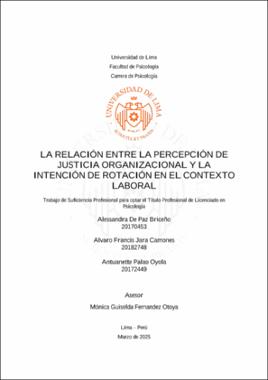
La relación entre la percepción de justicia organizacional y la intención de rotación en el contexto laboral
| dc.contributor.advisor | Fernández Otoya, Mónica Guiselda | |
| dc.contributor.author | De Paz Briceño, Alessandra | |
| dc.contributor.author | Jara Camones, Alvaro Francis | |
| dc.contributor.author | Palao Oyola, Antuanette | |
| dc.date.accessioned | 2025-05-21T00:25:47Z | |
| dc.date.available | 2025-05-21T00:25:47Z | |
| dc.date.issued | 2025 | |
| dc.identifier.uri | https://hdl.handle.net/20.500.12724/22745 | |
| dc.description.abstract | El presente reporte revisa la relación actual entre las variables: justicia organizacional e intención de rotación. El problema actual es que, en Latinoamérica, el Perú ocupa el tercer lugar en tasa de rotación de colaboradores. Desde la psicología, el objetivo es identificar cuál de las dimensiones de justicia organizacional (procedimental, distributiva, interpersonal e informacional) causa la movilización más intensa de la variable intención de rotación. Se realizó una búsqueda sistemática en las bases de datos Scopus y Web of Science, aplicando criterios PRISMA para garantizar rigurosidad metodológica. Se seleccionaron estudios de regresión fundamentalmente sobre justicia organizacional y rotación, con 10 artículos relevantes. Los resultados muestran que la dimensión de justicia procedimental causa la movilización indirecta, más intensa, de la variable intención de rotación, consolidándose como la dimensión más relevante. | es_PE |
| dc.description.abstract | This report examines the current relationship between the variables organizational justice and turnover intention. The current issue is that in Latin America, Peru ranks third in employee turnover rates. From a psychological perspective, the objective is to identify which dimension of organizational justice (procedural, distributive, interpersonal, or informational) causes the most intense mobilization of turnover intention. A systematic search was conducted in the Scopus and Web of Science databases, applying PRISMA criteria to ensure methodological rigor. Studies primarily focusing on regression analysis of organizational justice and turnover were selected, resulting in 10 relevant articles. The results show that procedural justice causes the strongest indirect mobilization of turnover intention, establishing itself as the most influential dimension. | en_EN |
| dc.format | application/pdf | |
| dc.language.iso | spa | |
| dc.publisher | Universidad de Lima | es_PE |
| dc.rights | info:eu-repo/semantics/openAccess | * |
| dc.rights.uri | https://creativecommons.org/licenses/by-nc-sa/4.0/ | * |
| dc.subject | Justicia organizacional | es_PE |
| dc.subject | ||
| dc.subject | ||
| dc.subject | Organizational justice | en_EN |
| dc.title | La relación entre la percepción de justicia organizacional y la intención de rotación en el contexto laboral | es_PE |
| dc.title.alternative | The relationship between organizational justice perception and turnover intention in the workplace context | en_EN |
| dc.type | info:eu-repo/semantics/bachelorThesis | |
| thesis.degree.level | Título Profesional | es_PE |
| thesis.degree.discipline | Psicología | es_PE |
| thesis.degree.grantor | Universidad de Lima. Facultad de Psicología | es_PE |
| dc.publisher.country | PE | |
| dc.type.other | Trabajo de suficiencia profesional | es_PE |
| thesis.degree.name | Licenciado en Psicología | es_PE |
| renati.advisor.orcid | https://orcid.org/0000-0003-1295-5042 | |
| renati.discipline | 313016 | |
| dc.identifier.isni | 0000000121541816 | |
| renati.author.dni | 72178006 | |
| renati.author.dni | 76682244 | |
| renati.author.dni | 72505824 | |
| renati.level | https://purl.org/pe-repo/renati/level#tituloProfesional | * |
| renati.advisor.dni | 10874613 | |
| renati.juror | Linares Weilg, Jorge Luis | |
| renati.juror | Flores Flores, Carlos Eduardo | |
| renati.juror | Fernández Otoya, Mónica Guiselda | |
| renati.type | https://purl.org/pe-repo/renati/type#trabajoDeSuficienciaProfesional | * |
| dc.subject.ocde | https://purl.org/pe-repo/ocde/ford#5.01.00 | |
| ulima.cat | OI |
Ficheros en el ítem


Este ítem aparece en la(s) siguiente(s) colección(ones)

Excepto si se señala otra cosa, la licencia del ítem se describe como info:eu-repo/semantics/openAccess